Datadog vs. Dynatrace: Enterprise APM Comparison 2025
Compare Datadog and Dynatrace to choose the right enterprise APM solution for 2025. This complete guide covers features, pricing, performance monitoring capabilities, and real use cases. Learn which platform fits your organization's needs and get insights for making the best monitoring investment.
Choosing the right Application Performance Monitoring (APM) solution for your enterprise isn't just about features, it's about making a strategic decision that impacts your entire organization's observability strategy. We've spent considerable time evaluating both Datadog and Dynatrace in enterprise environments, and the differences run deeper than most comparison articles suggest.
The APM market has evolved significantly, with enterprises demanding more than basic monitoring. Today's organizations need AI-driven insights, automatic discovery capabilities, and transparent total cost of ownership models. Both Datadog and Dynatrace promise these capabilities, but they deliver them in fundamentally different ways.
This comparison examines how these two leading APM platforms stack up for enterprise use cases. We'll break down their AI-driven insights, automatic discovery features, and real-world TCO implications based on our hands-on experience and market analysis. By the end, you'll have a clear framework for making this critical infrastructure decision.
Quick Comparison Overview
Here's where Datadog and Dynatrace stand for enterprise APM in 2025:
| Aspect | Datadog | Dynatrace |
|---|---|---|
| Market Position (2025) | Recognized as a Leader in the 2025 Gartner Magic Quadrant for Observability Platforms, noted for breadth in cloud-native observability. | Named a Leader in the 2025 Gartner Magic Quadrant for Observability Platforms, positioned highest for Ability to Execute. |
| Estimated Market Share (Public Range) | ~15–25% (varies by report and market segment). Strong SaaS adoption and fast revenue growth across cloud observability. (Future Market Insights, 2025) | ~10–16% (enterprise-focused segment). High adoption among large-scale, hybrid infrastructures. (Future Market Insights, 2025) |
| Primary Strength | Deep integrations with cloud-native stacks, microservices, and containers; simple onboarding and unified dashboards. | Advanced AI-driven observability and automation, including Davis AI for root cause detection. |
| Target Audience | Cloud-first organizations and scaling startups using modern architectures (Kubernetes, microservices). | Large enterprises managing hybrid and multi-cloud environments requiring automation and deep visibility. |
| Pricing Model | Usage-based SaaS pricing (pay-per-metric/logs/traces); flexible for scaling workloads. | Premium pricing based on feature tiers; emphasizes ROI from tool consolidation and automation. |
| Platform Support | Primarily cloud-native with hybrid support via agents and APIs; SaaS delivery model. | Broad coverage for cloud, on-premises, and hybrid deployments. |
| Learning Curve | Moderate; intuitive UI and fast setup for standard monitoring needs. | Steeper; rich features and advanced AI require more configuration. |
| Customer Ratings (Gartner Peer Insights, 2025) | ~4.5★ (840+ reviews) for Observability Platforms. | ~4.6★ (1600+ reviews) for Observability Platforms. |
Both platforms earned their market positions through different approaches. Datadog leads in mindshare through aggressive cloud-native adoption, while Dynatrace maintains its enterprise stronghold through comprehensive AI-driven capabilities.
Datadog: Cloud-Native APM Leader
Overview and Positioning
Datadog has positioned itself as the go-to APM solution for cloud-native enterprises since its 2010 founding. The New York-based company built its reputation on making observability accessible to growing organizations, and that philosophy still drives their product development.
What sets Datadog apart is its unified platform approach. Instead of cobbling together separate monitoring tools, enterprises get infrastructure monitoring, APM, log management, and real-user monitoring from a single vendor. This integration advantage becomes crucial when you're managing hundreds of microservices across multiple cloud providers.
Key Features and Capabilities
Datadog's APM capabilities center around distributed tracing with automatic instrumentation for major programming languages. The platform excels at correlating application performance with infrastructure metrics, giving you context that standalone APM tools can't provide.
Their integration ecosystem is genuinely impressive, over 400 built-in integrations means you can monitor everything from AWS Lambda functions to Kafka clusters without custom development. The unified dashboards pull data from all these sources, creating a single pane of glass for your entire stack.
Real-user monitoring adds another layer of insight, connecting backend performance issues to actual user impact. We've found this particularly valuable for prioritizing performance improvements based on business impact rather than just technical metrics.
Strengths and Ideal Use Cases
Datadog shines in cloud-native environments where rapid scaling is the norm. The platform handles dynamic infrastructure beautifully, containers, serverless functions, and auto-scaling groups all get monitored automatically as they spin up and down.
The learning curve is manageable, which matters when you're trying to get entire development teams using APM data for troubleshooting. Developers can quickly create custom dashboards and alerts without requiring extensive training.
Cost predictability is another strength, at least initially. The pay-as-you-go model means you're not paying for unused capacity, and the pricing scales naturally with your infrastructure growth.
Limitations and Considerations
The biggest challenge with Datadog is cost management at scale. While the incremental pricing model seems attractive, data consumption can spiral quickly in large environments. We've seen enterprises struggle with unexpected bills when log volumes spike or when teams over-instrument their applications.
On-premise support is limited, which creates challenges for enterprises with hybrid cloud strategies or regulatory requirements that keep some workloads on-premises. The platform was built for cloud-first architectures, and it shows.
AI-driven insights exist but aren't as sophisticated as Dynatrace's offering. Datadog provides anomaly detection and some automated root cause analysis, but you'll still need experienced engineers to interpret the results and take action.
Pricing Structure
Datadog's pricing starts at reasonable levels but can become complex quickly. APM pricing is per monitored host, with additional charges for custom metrics, log retention, and advanced features. There's no free tier for APM, which limits your ability to evaluate the platform thoroughly before committing.
The pay-as-you-go model works well for growing companies but requires careful monitoring in large enterprises. We recommend implementing cost controls and monitoring your monthly spend closely, especially during initial deployment phases.
Dynatrace: AI-Powered Enterprise Monitoring
Overview and Positioning
Dynatrace has been in the APM game since 2005, and their enterprise focus shows in every aspect of their platform. The Massachusetts-based company built their reputation on providing deep visibility into complex application environments, and they've doubled down on AI-driven automation in recent years.
Unlike Datadog's unified platform approach, Dynatrace focuses on being the most comprehensive APM solution available. Their PurePath technology provides method-level visibility that goes deeper than typical distributed tracing, while their AI engine, Davis, automatically discovers dependencies and identifies root causes.
Key Features and Capabilities
Dynatrace's standout feature is its AI-powered root cause analysis. The Davis AI engine doesn't just alert you to problems, it analyzes the entire dependency chain and pinpoints the likely cause. This capability becomes incredibly valuable in complex enterprise environments where a single issue might cascade through dozens of interconnected services.
PurePath technology provides unprecedented visibility into application execution. Instead of sampling traces like most APM tools, Dynatrace captures complete transaction paths, including method-level details and database queries. This depth of insight is particularly valuable for troubleshooting complex performance issues.
Automatic discovery is another strength. The platform automatically maps your entire application topology, including dependencies you might not even know exist. This capability is crucial for enterprises dealing with legacy applications and complex integration patterns.
Strengths and Ideal Use Cases
Dynatrace excels in complex enterprise environments where multiple teams manage interconnected applications. The AI-driven insights reduce the mean time to resolution significantly, which translates to real cost savings in large organizations.
The platform's support for hybrid environments is comprehensive. Whether you're running applications on-premises, in the cloud, or across multiple cloud providers, Dynatrace provides consistent monitoring and insights.
Enterprise support is where Dynatrace really shines. Their guardian programs provide personalized support that helps organizations optimize their monitoring strategy and get maximum value from the platform.
Limitations and Considerations
The learning curve is steep. Dynatrace's advanced features require significant training and expertise to use effectively. This can slow adoption, especially in organizations where multiple teams need to use the platform.
Pricing complexity is a real challenge. While the platform can provide strong ROI through tool consolidation and reduced downtime, the initial cost can be shocking for organizations used to simpler pricing models.
Integration capabilities, while broad, sometimes require more customization than Datadog's plug-and-play approach. This can increase implementation time and complexity.
Pricing Structure
Dynatrace uses a premium pricing model that reflects its enterprise positioning. There's no free tier, and the entry-level pricing is significantly higher than Datadog's starting point. However, the platform's ability to consolidate multiple monitoring tools can offset these costs in large organizations.
The pricing model includes full-stack monitoring, AI-powered insights, and enterprise support. While expensive upfront, organizations often see strong ROI through reduced downtime and faster problem resolution.
Head-to-Head Feature Comparison
| Feature | Datadog | Dynatrace |
|---|---|---|
| AI-Driven Insights | Anomaly detection, basic root cause analysis | Davis AI engine, advanced root cause analysis |
| Automatic Discovery | Infrastructure and service discovery | Complete topology mapping with dependencies |
| Distributed Tracing | Standard sampling-based tracing | PurePath method-level visibility |
| Platform Support | Cloud-native, limited on-premise | Cloud, on-premise, hybrid |
| Integration Ecosystem | 400+ built-in integrations | Broad integrations, some customization required |
| Real-User Monitoring | Comprehensive RUM capabilities | Advanced RUM with AI insights |
| Learning Curve | Moderate, developer-friendly | Steep, enterprise-focused |
| Cost Model | Pay-as-you-go, incremental scaling | Premium pricing, tool consolidation ROI |
The feature comparison reveals fundamental philosophical differences. Datadog prioritizes ease of use and integration breadth, while Dynatrace focuses on depth of insight and AI-driven automation.
Performance-wise, both platforms handle enterprise-scale workloads effectively. Datadog's cloud-native architecture provides excellent scalability for modern applications, while Dynatrace's comprehensive monitoring supports complex, hybrid environments.
Use Case Scenarios
When to Choose Datadog
Datadog makes sense for cloud-native enterprises that prioritize integration breadth and cost predictability. If your organization is primarily running containerized applications on AWS, Azure, or GCP, Datadog's extensive integration ecosystem provides immediate value.
Growing companies that need to scale their monitoring capabilities gradually will appreciate Datadog's incremental pricing model. The platform grows with your organization without requiring significant upfront investment.
Development teams that need to quickly implement monitoring and alerting will find Datadog's learning curve manageable. The platform's developer-friendly approach means faster adoption and better utilization across your engineering organization.
When to Choose Dynatrace
Dynatrace is the right choice for large enterprises with complex, hybrid environments. If you're managing legacy applications alongside modern cloud-native services, Dynatrace's comprehensive monitoring capabilities provide the visibility you need.
Organizations struggling with lengthy troubleshooting processes will benefit from Dynatrace's AI-driven root cause analysis. The platform's ability to automatically identify issues and their causes can significantly reduce mean time to resolution.
Enterprises looking to consolidate multiple monitoring tools should consider Dynatrace's comprehensive platform. While the initial cost is higher, the ability to replace several point solutions can provide strong ROI.
Migration and Implementation
Datadog Implementation
Datadog's cloud-native architecture makes implementation relatively straightforward for cloud-based applications. The platform's extensive documentation and agent-based approach mean you can typically get basic monitoring up and running within days.
However, cost management requires careful planning. We recommend starting with a pilot program to understand your data consumption patterns before rolling out organization-wide. This approach helps avoid unexpected billing surprises.
Dynatrace Implementation
Dynatrace implementation is more complex but offers automated deployment options that can simplify the process. The platform's AI-driven discovery means you'll get comprehensive visibility quickly, but you'll need skilled engineers to interpret and act on the insights.
The learning curve requires investment in training and potentially external consulting. However, organizations that make this investment typically see faster problem resolution and better overall application performance.
Decision Framework
Key Questions to Ask
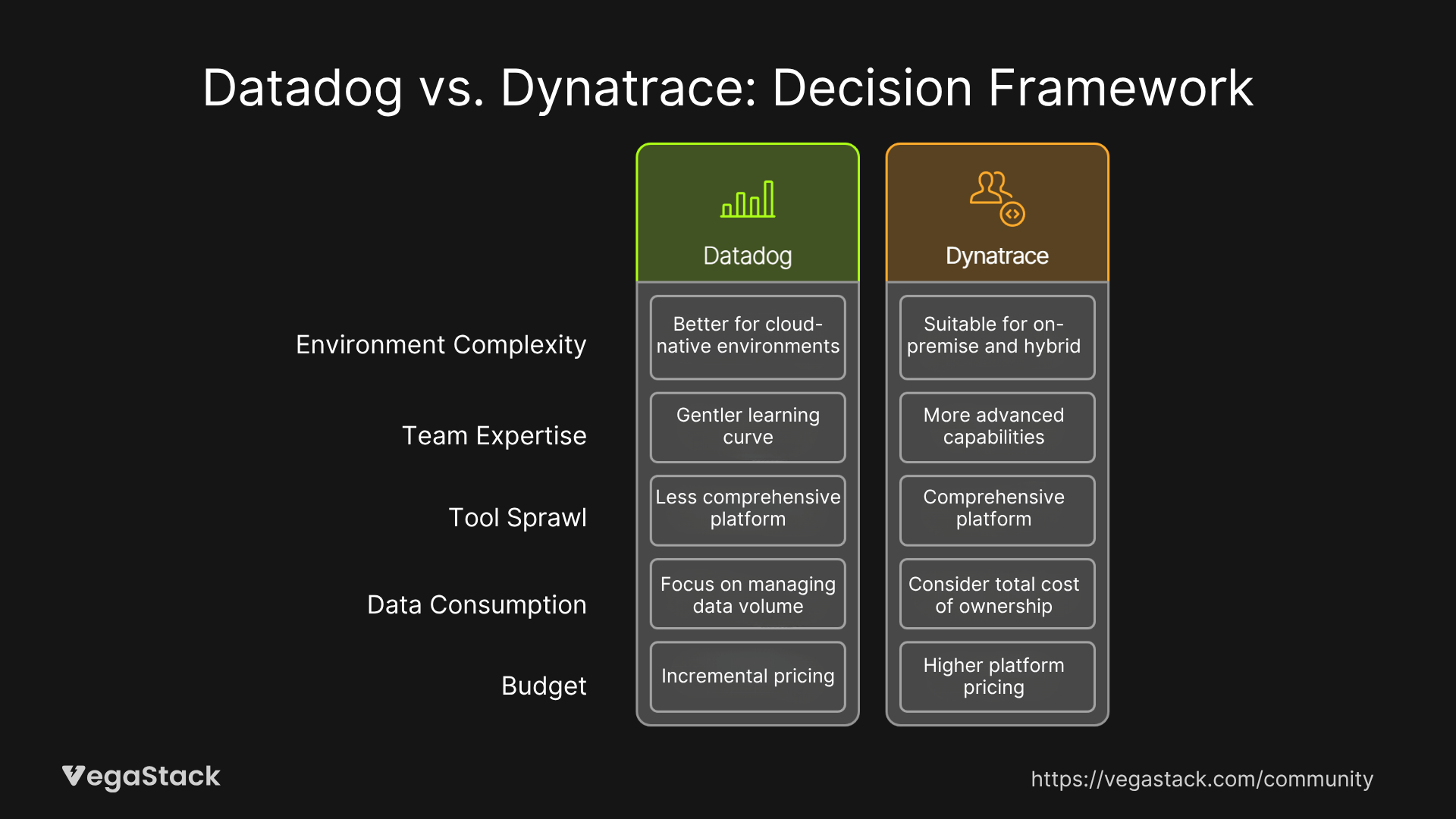
Start with your environment complexity. Are you primarily cloud-native, or do you have significant on-premise and hybrid requirements? This fundamental question often determines which platform will serve you better.
Consider your team's expertise and available training time. Datadog's gentler learning curve might be worth trading off against Dynatrace's more advanced capabilities if you need faster adoption.
Evaluate your current tool sprawl. If you're already using multiple monitoring solutions, Dynatrace's comprehensive platform might provide better long-term value despite higher initial costs.
Budget Considerations
For Datadog, focus on understanding your data consumption patterns. The platform's incremental pricing can be cost-effective, but only if you manage your data volume carefully. Budget for potential cost spikes during incident response when logging and metrics collection typically increase.
For Dynatrace, consider the total cost of ownership including tool consolidation opportunities. While the platform pricing is higher, the ability to replace multiple point solutions can provide net savings for large organizations.
Conclusion & Recommendations
Both Datadog and Dynatrace have earned their market positions through different approaches to enterprise APM. Datadog excels in cloud-native environments where integration breadth and cost predictability matter most. Dynatrace dominates in complex enterprise environments where AI-driven insights and comprehensive monitoring justify premium pricing.
For cloud-first organizations with moderate complexity, Datadog's unified platform approach provides excellent value. The extensive integration ecosystem and manageable learning curve make it an excellent choice for growing companies.
For large enterprises with complex, hybrid environments, Dynatrace's AI-powered insights and comprehensive monitoring capabilities provide superior value. The platform's ability to automatically discover dependencies and identify root causes can significantly reduce operational overhead.
The decision ultimately comes down to your specific environment, team capabilities, and budget constraints. We recommend evaluating both platforms with pilot programs that reflect your actual use cases rather than relying solely on vendor demonstrations.
Remember that APM tool selection is a strategic decision that will impact your organization for years. Choose the platform that aligns with your long-term architecture and organizational goals, not just your immediate needs.