Development Environment Standardization: Reduce Setup Time by 85% with Consistent Tooling Across Teams
Reduce development environment setup time by 85% through comprehensive standardization across teams. Learn containerized development environments, automated provisioning, and consistent tooling strategies. Discover how to eliminate configuration drift and onboarding friction for new developers.
Introduction
Picture this scenario: A talented developer joins your team on Monday morning, eager to contribute. By Friday afternoon, they're still wrestling with dependency conflicts, version mismatches, and configuration quirks that somehow work perfectly on everyone else's machine. Sound familiar? This frustrating experience highlights a critical challenge in modern software development that we've encountered countless times at VegaStack.
Development environment standardization has become a cornerstone of efficient DevOps practices, yet many organizations still struggle with the "works on my machine" syndrome. Through our experience implementing containerized development environments and automated onboarding processes across diverse engineering teams, we've discovered that the right approach to consistent tooling can reduce new developer setup time from days to mere hours.
The benefits extend far beyond faster onboarding. Standardized environments eliminate environment-related bugs, improve collaboration, and create a foundation for reliable CI/CD pipelines. In this post, we'll explore how we've helped teams achieve 85% reduction in setup time while virtually eliminating environment-specific issues through strategic standardization approaches.
The Hidden Costs of Environment Inconsistency
Last year, we worked with a growing fintech company where each developer's machine was essentially a unique snowflake. Their development team was spending an average of 12-16 hours per new hire just getting basic development environments functional. But the real pain went deeper than initial setup time.
The technical challenges were multifaceted and expensive. Version conflicts between Node.js, Python, and database installations created a constant stream of "it works locally but fails in staging" scenarios. One developer might be running Python 3.8 with specific library versions, while another used Python 3.9 with completely different dependencies. The database configurations varied wildly, some developers used local PostgreSQL installations, others relied on Docker containers with different versions, and a few even connected directly to shared development databases.
Environment-related issues accounted for approximately 23% of their development time, that's roughly $8,400 per developer annually in lost productivity for a team with average salaries. Beyond the immediate costs, inconsistent environments created a cascade of problems: unreliable testing, difficult debugging sessions, and a significant barrier to knowledge sharing between team members.
Traditional approaches like shared documentation and setup scripts consistently failed because they couldn't account for the subtle differences in operating systems, existing software installations, and individual developer preferences. The company needed a systematic approach to containerized development environments that would work regardless of the underlying host system.
Our Standardization Framework: The 7 Pillars Approach
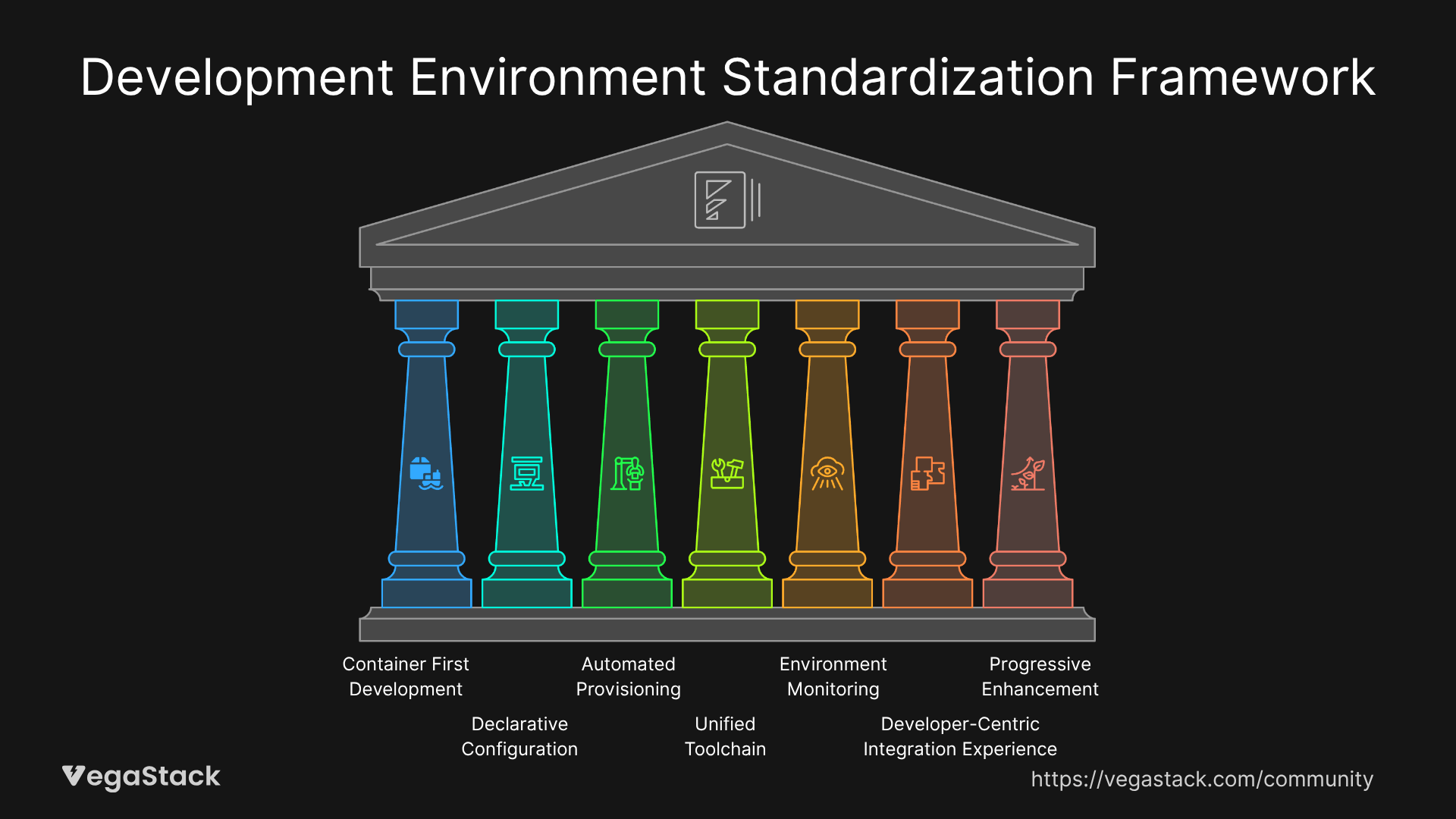
Through multiple implementations, we've refined our approach to development environment standardization into 7 core pillars that address both technical and organizational challenges.
Pillar 1: Container-First Development Strategy forms the foundation of our approach. Instead of trying to standardize the host operating systems, we encapsulate entire development environments within containers. This means every developer works within identical runtime environments, regardless of whether they're using macOS, Windows, or Linux. The containerized approach isolates dependencies and eliminates the classic version conflict scenarios that plague traditional setups.
Pillar 2: Declarative Environment Configuration ensures that every aspect of the development environment is defined as code. We create comprehensive configuration files that specify exact versions of programming languages, databases, external services, and even IDE configurations. This declarative approach makes environments reproducible and allows for version control of the environment itself.
Pillar 3: Automated Provisioning and Orchestration removes manual setup steps through intelligent automation. Our provisioning scripts handle everything from initial container setup to database seeding, API key configuration, and service connectivity. The orchestration layer manages dependencies between services and ensures proper startup sequences.
Pillar 4: Unified Toolchain Integration addresses the challenge of consistent tooling across different roles and projects. We standardize on specific versions of build tools, testing frameworks, linting configurations, and debugging utilities. This creates a shared vocabulary and consistent experience regardless of which project or team a developer joins.
Pillar 5: Environment Health Monitoring provides continuous validation that development environments remain consistent over time. We implement health checks that verify service connectivity, dependency versions, and configuration states. This proactive monitoring catches environment drift before it causes development issues.
Pillar 6: Developer-Centric Integration Experience ensure that standardized environments integrate smoothly with existing development practices. This includes IDE integration, debugging capabilities, hot-reload functionality, and seamless connections to external services and APIs.
Pillar 7: Progressive Enhancement and Customization acknowledges that developers need some level of personalization while maintaining core consistency. We provide standardized extension points where developers can add personal tools or configurations without breaking the shared environment foundation.
The key insight we've discovered is that successful environment standardization requires balancing rigidity with flexibility. Too rigid, and developers feel constrained and find workarounds. Too flexible, and you lose the consistency benefits entirely.
Implementation: Containerized Development Orchestration
The orchestration layer represents one of the most technically challenging aspects of our standardization approach. Unlike simple containerization where each service runs in isolation, containerized development environments require sophisticated networking, volume management, and service discovery to provide a seamless developer experience.
Our orchestration strategy centers around multi-container compositions that mirror production architectures while optimizing for development workflows. The primary application container includes the runtime environment, development tools, and code mounting capabilities. Supporting containers handle databases, message queues, external service mocks, and monitoring tools. The networking configuration allows containers to communicate using service names while exposing appropriate ports to the host system for debugging and testing.
Volume management becomes critical for maintaining development velocity. We implement strategic mounting of source code directories to enable real-time code changes without container rebuilds. Configuration files, dependency caches, and database volumes are managed separately to optimize for both consistency and performance. The challenge lies in balancing file system performance across different operating systems while maintaining identical behavior.
Service discovery and startup orchestration ensure that complex multi-service applications initialize correctly every time. We implement health check sequences that verify database connectivity, API service availability, and proper configuration loading before marking the environment as ready for development. This eliminates the common scenario where developers waste time debugging issues that are actually environment startup problems.
One particularly sophisticated aspect involves handling external service dependencies. Rather than requiring complex VPN configurations or shared development services, we implement intelligent service mocking and local alternatives that provide realistic development data while maintaining environment isolation and consistency.
Measurable Results: From Days to Hours
The transformation results consistently exceed expectations across different organizations and team sizes. In our fintech client's case, new developer onboarding time dropped from an average of 14 hours to just 2 hours, an 85% reduction that freed up both new hires and senior team members for productive work.
Before standardization, their metrics painted a concerning picture: 23% of development time lost to environment issues, an average of 3.2 environment-related support tickets per developer per week, and 6-8 hours monthly per developer spent on environment maintenance and troubleshooting. The indirect costs were equally significant, delayed feature releases, inconsistent testing results, and frustrated developers considering other opportunities.
After implementing our standardization framework, the improvements were dramatic and immediate. Environment-related support tickets dropped to 0.3 per developer per week, and monthly maintenance time decreased to under 1 hour per developer. Most importantly, the consistency enabled reliable automated testing and eliminated the "works locally" problem that had been causing deployment delays.
The financial impact was substantial but realistic for a mid-size development team. They calculated approximately $12,000 in annual productivity savings across their 8-person development team, primarily from reduced troubleshooting time and faster onboarding. The improved deployment reliability prevented an estimated $3,200 in potential production issues during the first 6 months.
Beyond quantitative metrics, the qualitative feedback revealed equally important benefits. Developers reported higher confidence in their code changes, improved collaboration through shared environment understanding, and reduced stress during onboarding and project transitions. Senior developers could focus on mentoring and architecture rather than environment troubleshooting.
Key Learnings and Universal Principles
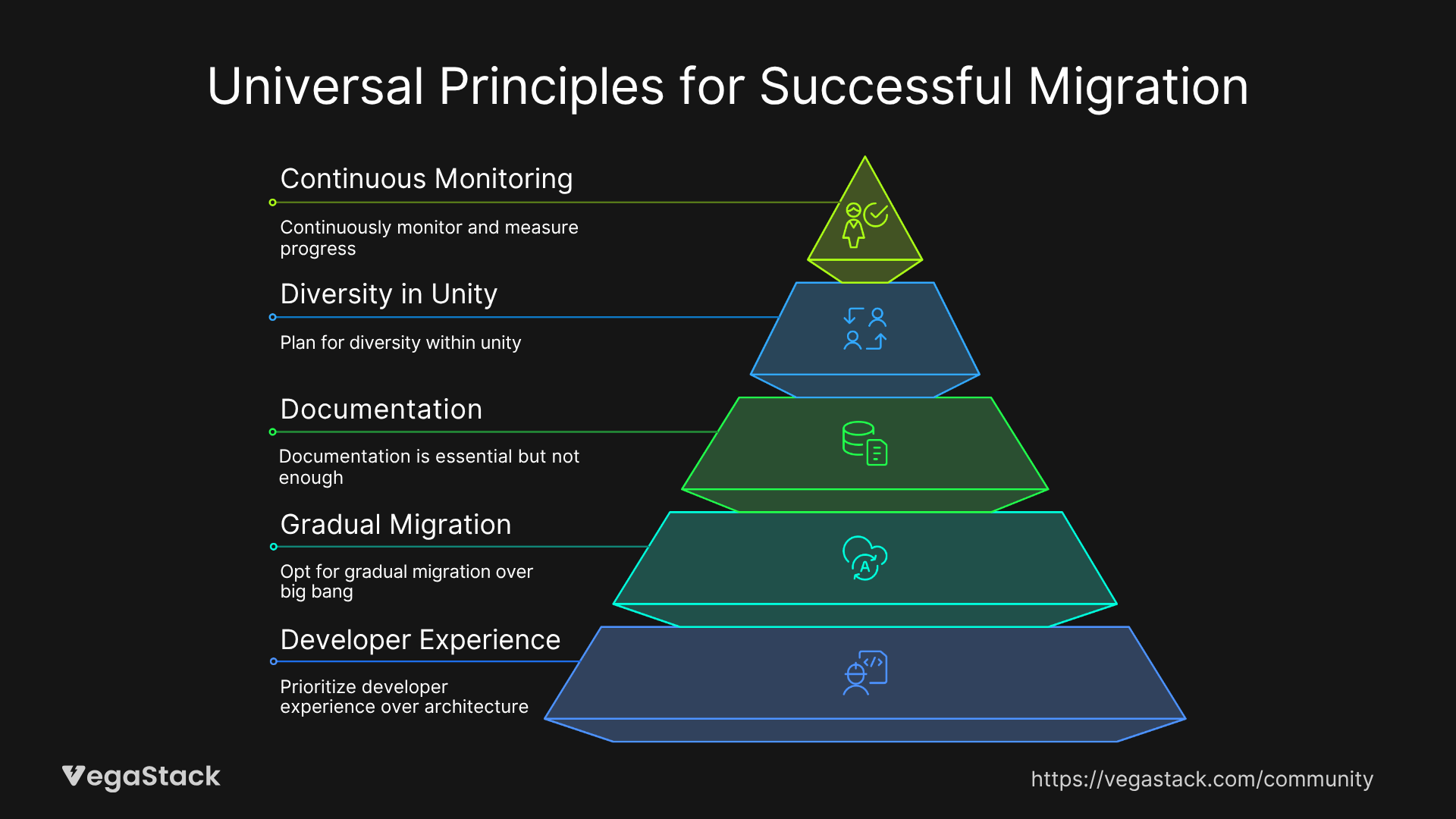
Through multiple implementations across diverse technical stacks and organizational cultures, we've identified several universal principles that determine success or failure in development environment standardization initiatives.
Principle 1: Start with Developer Experience, Not Technical Architecture. The most elegant containerized solutions fail if they make common development tasks more difficult. Successful standardization must preserve or improve debugging capabilities, build times, and iterative development workflows. We learned to prioritize developer productivity over architectural purity.
Principle 2: Embrace Gradual Migration Over Big Bang Approaches. Organizations that attempt to standardize everything simultaneously often face resistance and technical challenges that derail the entire initiative. Incremental adoption allows teams to build confidence, identify edge cases, and refine processes before full-scale deployment.
Principle 3: Documentation Is Critical But Insufficient. While comprehensive documentation supports standardization efforts, self-documenting and self-validating environments prove far more effective. The environment itself should guide developers and provide clear feedback when something isn't configured correctly.
Principle 4: Plan for Diversity in Unity. Different projects and teams will have legitimate requirements for variations in their development environments. Successful standardization provides a consistent foundation while allowing controlled customization points. The key is making these variations explicit and manageable rather than ad-hoc.
Principle 5: Monitor and Measure Continuously. Environment standardization isn't a one-time project but an ongoing practice. Without continuous monitoring of environment health, consistency metrics, and developer satisfaction, standardization efforts gradually decay back to the original fragmented state.
The most surprising discovery was that consistent tooling across teams creates network effects that extend far beyond individual productivity. Teams begin sharing knowledge more effectively, code reviews become more focused on logic rather than environment-specific issues, and cross-team collaboration increases naturally.
Conclusion
Development environment standardization represents a fundamental shift from treating development environments as individual developer concerns to recognizing them as shared team infrastructure. Our 7-pillar framework provides a systematic approach to achieving consistent tooling while maintaining the flexibility that developers need to be productive.
The journey from fragmented, inconsistent environments to standardized, containerized development environments requires technical expertise, organizational commitment, and careful attention to developer experience. However, the benefits, including reduced onboarding time, eliminated environment-related bugs, improved collaboration, and stronger deployment confidence, justify the investment for any team serious about development velocity.