How Dropbox Scaled to 30 Million Tasks Per Minute: A 5-Layer Infrastructure Transformation
Dropbox's journey to processing 30 million tasks per minute required a complete infrastructure overhaul. Their 5-layer transformation reveals proven strategies for handling massive scale, from data processing pipelines to distributed systems architecture that modern companies can apply today.
The Asynchronous Infrastructure Challenge That Was Costing Millions
When your platform processes over 30 billion requests daily and supports 400+ product use cases, including cutting-edge AI innovations like Dropbox Dash, infrastructure reliability isn't just a technical concern, it's a business imperative. According to the Dropbox engineering team, their asynchronous infrastructure had hit a critical breaking point by 2021, creating cascading problems that threatened both developer productivity and business growth.
The stakes were enormous. With multiple fragmented systems handling everything from file uploads to AI-powered search capabilities, Dropbox faced mounting operational costs, reliability risks, and development bottlenecks that were slowing innovation to a crawl. The engineering team knew they needed a fundamental transformation, but with 400+ existing business use cases, they couldn't afford to start from scratch.
Their solution? A revolutionary 5-layer messaging system model that would eventually enable them to process 30 million tasks every minute while dramatically improving developer velocity and system reliability.
The Business Pain Behind Technical Complexity
By 2021, Dropbox's infrastructure comprised multiple independent asynchronous systems, each custom-built for specific product requirements. While functionally diverse, supporting everything from security workflows to machine learning pipelines, these systems shared a common problem: they were becoming increasingly expensive and difficult to maintain.
The business impact was measurable and growing. Product engineers faced steep learning curves that significantly slowed feature development. Each new use case required extensive capacity planning and operational overhead, effectively taxing the engineering team's ability to innovate. More critically, the systems lacked multi-homing capabilities, creating single points of failure that could impact multiple business functions simultaneously.
Perhaps most concerning was the scalability ceiling. Critical components like the delayed event scheduler had maxed out their throughput capacity, forcing the team to implement screening protocols for new use cases, essentially rationing innovation based on infrastructure limitations rather than business priorities.
The lambda infrastructure presented its own challenges, operating below peak efficiency and lacking autoscaling capabilities. This meant manual intervention was required during high-load periods, creating both operational burden and potential service disruptions during critical business moments.
The Strategic Decision: Evolution Over Revolution
Faced with supporting 400+ existing business use cases, Dropbox's engineering team made a crucial strategic decision. Rather than building an entirely new system from scratch, which would have required massive migration efforts and business disruption, they chose a phased transformation approach.
This decision reflected sophisticated technical leadership. The team recognized that revolutionary changes, while appealing from an engineering perspective, would create unacceptable business risk. Instead, they outlined three primary transformation goals that would guide their incremental approach:
Development Velocity: Simplify the asynchronous interface to accelerate product development while reducing operational burden on engineering teams through automated release practices and intelligent rollback capabilities.
Robust Foundation: Unify common patterns across existing systems and create extensible components that could support new use cases without requiring entirely new system builds.
Operational Efficiency: Streamline infrastructure by eliminating redundant systems and transitioning lambda infrastructure to Dropbox's service-oriented architecture stack for improved efficiency and monitoring.
The overarching success metric was clear: reduce "time to launch" for product engineers deploying new use cases while minimizing weekly operational overhead for platform teams.
The 5-Layer Messaging System Model: A Technical Architecture With Business Impact
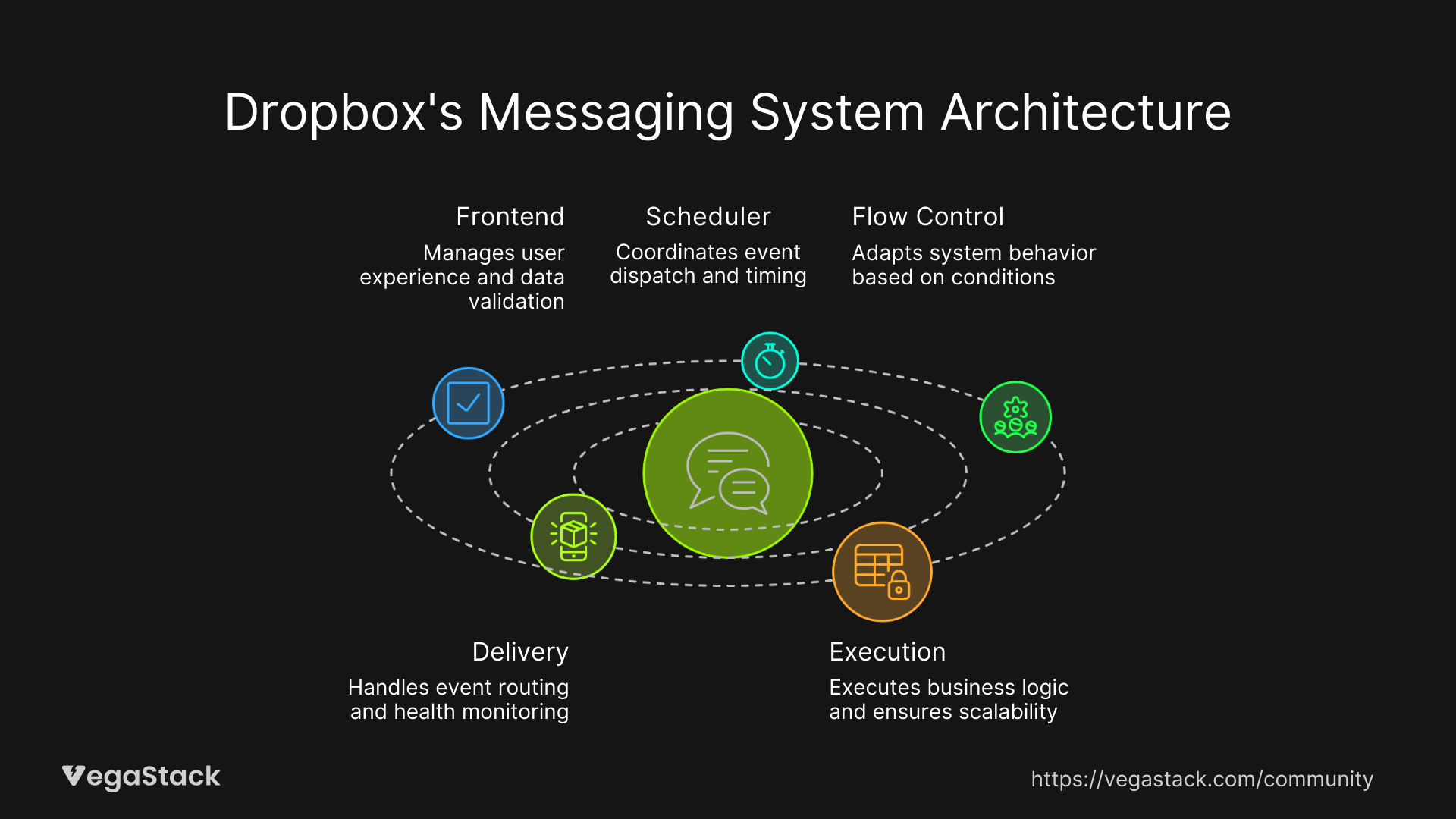
Drawing inspiration from the OSI networking model, Dropbox's team deconstructed their asynchronous infrastructure into five distinct layers, each serving specific business functions while maintaining flexibility for future innovation.
Layer 1: Frontend - The Gateway to Developer Productivity
The frontend layer serves as the primary interface between product engineers and the asynchronous system. Think of it as the "user experience" layer for internal development teams. This layer manages two critical user groups: product engineers who programmatically enqueue events, and systems like databases that need to trigger business workflows based on data changes.
The business value here is substantial. By implementing rigorous schema validation and standardizing message formats (JSON, Proto, Avro into protocol buffers), the frontend layer prevents costly integration errors and reduces debugging time. The schema registry ensures that published events conform to predefined contracts with subscribers, eliminating a major source of production issues.
Most importantly, this layer guarantees event durability, ensuring that no business-critical tasks are lost during system failures, which directly translates to customer trust and revenue protection.
Layer 2: Scheduler - The Orchestration Engine
The scheduler functions as the central coordination hub, managing event dispatch across various consumers and use cases. For change data capture scenarios, it interfaces with external data sources to determine relevant payload ranges. For delayed execution requirements, it maintains separate storage for time-sensitive events, ensuring precise delivery timing.
From a business perspective, the scheduler's order management capabilities are crucial for maintaining data consistency across Dropbox's ecosystem. This is particularly important for AI features like Dropbox Dash, where event ordering can impact search accuracy and user experience.
Layer 3: Flow Control - Smart Resource Management
Flow control represents the intelligent layer that adapts system behavior based on real-time conditions. It dynamically adjusts task distribution based on subscriber availability, task priority, and system health, essentially serving as an automated operations manager.
The business impact is significant: by detecting when subscribers can't handle throughput effectively and automatically adjusting rates, this layer prevents system overloads that could cascade into customer-facing outages. The state management functionality ensures robust task retry mechanisms, directly impacting system reliability metrics.
Layer 4: Delivery - The Last-Mile Solution
The delivery layer handles the critical "last mile" of event routing, directing messages to appropriate services or lambda functions across various hosting environments, including public clouds like AWS and Azure. This layer enables sophisticated message filtering based on subscriber preferences and manages delivery retries for transient failures.
For a company operating at Dropbox's scale, this layer's health monitoring capabilities are business-critical. By continuously monitoring subscriber health and routing events only to healthy hosts, it prevents the cascade failures that could impact millions of users.
Layer 5: Execution - Where Business Logic Happens
The execution layer is where the actual business value is delivered, where lambda functions and remote processes handle events and execute business logic. At Dropbox, this layer is backed by Atlas, their autoscaling infrastructure that includes release-time validation hooks.
The autoscaling capabilities directly impact operational costs by ensuring resources scale with demand rather than maintaining static capacity. The validation and rollback features protect against code changes that could degrade service uptime, a direct protection against revenue impact.
Implementation Results: Transforming Technical Metrics Into Business Value
The transformation delivered measurable business impact across multiple dimensions. The unified architecture eliminated the operational complexity of managing multiple independent systems, reducing the engineering overhead that was constraining innovation velocity.
Most significantly, the new architecture positioned Dropbox to handle their current scale of 30 million tasks per minute while providing the flexibility to support emerging AI use cases. The extensible design means new product features can be implemented without the previous requirement of building entirely new infrastructure systems.
The autoscaling capabilities backed by Atlas infrastructure eliminated the manual intervention previously required during high-load periods, reducing operational risk while improving resource efficiency. The multi-homing capabilities addressed critical reliability risks, ensuring that data center failures wouldn't cascade into business disruptions.
For product engineers, the simplified interface and automated operational features delivered on the primary goal of reducing "time to launch" for new use cases. The standardized release practices with automatic rollback capabilities reduced deployment risk while accelerating development cycles.
Key Lessons for Infrastructure Transformation
Dropbox's experience offers several transferrable insights for organizations facing similar infrastructure scaling challenges:
Customer-Centric Design: The team's emphasis on understanding internal customer (product engineer) requirements shaped every architectural decision. This approach ensured the technical solution addressed real business pain points rather than theoretical improvements.
Evolution Over Revolution: The phased transformation approach balanced technical innovation with business continuity. For organizations with substantial existing systems, this incremental strategy reduces risk while enabling continuous value delivery.
Layer Abstraction Creates Flexibility: By separating concerns into distinct layers, Dropbox created a system that can adapt to future requirements without fundamental restructuring. This architectural approach provides long-term scalability and maintainability.
Metrics-Driven Success Criteria: Focusing on business metrics like "time to launch" and operational overhead created clear success criteria that aligned technical work with business objectives.
Unified Standards Reduce Complexity: Standardizing interfaces, message formats, and operational practices across the five layers eliminated the maintenance overhead of multiple independent systems.
The Future of Scalable Infrastructure
Dropbox's 5-layer messaging system model demonstrates how thoughtful architectural decomposition can transform infrastructure challenges into competitive advantages. By processing 30 million tasks per minute while supporting 400+ use cases, they've created a foundation that enables rather than constrains innovation.
The model's success suggests that the future of enterprise infrastructure lies not in monolithic solutions, but in carefully designed layered architectures that balance standardization with flexibility. As AI and machine learning workloads become increasingly central to business value, this type of extensible, scalable infrastructure becomes essential for maintaining competitive advantage.
For organizations evaluating their own infrastructure transformation needs, Dropbox's experience provides a compelling blueprint: start with customer pain points, design for evolution rather than revolution, and measure success in business terms rather than purely technical metrics.