Spinnaker vs. ArgoCD: Multi-Cloud Deployment Platforms Comparison
Compare Spinnaker and ArgoCD to choose the right multi-cloud deployment platform. This complete guide covers features, deployment strategies, complexity, GitOps capabilities, and real use cases. Learn which tool fits your cloud deployment needs and get insights for managing releases at scale.
Choosing the right deployment platform for your multi-cloud strategy isn't just about features, it's about finding the tool that matches your complexity requirements and scales with your enterprise operations. We've spent months working with both Spinnaker and ArgoCD across different environments, and the differences run deeper than you might expect.
The reality is that Spinnaker vs. ArgoCD isn't an apples-to-apples comparison. One excels at complex multi-cloud orchestration while the other dominates Kubernetes-native GitOps workflows. Your choice depends on whether you need Netflix-scale deployment complexity or prefer the simplicity of GitOps-driven continuous delivery.
We'll break down the real-world differences between these multi-cloud deployment platforms, from setup complexity to enterprise-scale operations. You'll understand exactly when to choose each tool and what trade-offs you're making.
Quick Comparison Overview
Here's what you need to know upfront about these deployment platforms:
| Aspect | Spinnaker | ArgoCD |
|---|---|---|
| Primary Focus | Multi-cloud pipeline orchestration | Kubernetes GitOps deployment |
| Target Audience | Enterprise teams with complex deployments | Kubernetes-first organizations |
| Setup Complexity | High, requires significant expertise | Moderate, straightforward for K8s users |
| Multi-Cloud Support | Native support for AWS, GCP, Azure, on-premises | Limited to Kubernetes environments |
| Deployment Approach | Pipeline-based with custom stages | Git-driven declarative configuration |
| Pricing | Open source plus infrastructure costs | Open source plus optional enterprise support |
| Learning Curve | Steep, microservices architecture | Moderate, GitOps concepts |
| Best For | Large-scale multi-platform deployments | Cloud-native Kubernetes applications |
Both platforms are open source, but they solve fundamentally different problems. Spinnaker handles deployment complexity across multiple cloud providers, while ArgoCD streamlines Kubernetes deployments through GitOps principles.
Spinnaker Overview
Overview and Positioning
Spinnaker emerged from Netflix's need to deploy applications across multiple cloud providers at massive scale. Backed by Netflix, Google, and Microsoft, it's designed for organizations that can't afford deployment failures and need sophisticated release management across diverse environments.
The platform positions itself as the enterprise solution for teams managing complex, multi-cloud deployments. It's not trying to be simple, it's trying to be comprehensive. When you're deploying across AWS, GCP, Azure, and on-premises environments simultaneously, Spinnaker handles the orchestration complexity that would otherwise require custom tooling.
Key Features and Capabilities
Multi-Cloud Native Architecture: Spinnaker doesn't just support multiple clouds, it's built for them. We've used it to deploy identical applications across AWS ECS, Google Cloud Run, and Azure Container Instances from a single pipeline. The platform abstracts cloud-specific differences while giving you granular control over each environment.
Pipeline-Based Deployment Strategy: Every deployment in Spinnaker is a pipeline with customizable stages. You can include manual approval gates, automated testing phases, canary deployments, and rollback triggers. We've built pipelines with 15+ stages that handle everything from infrastructure provisioning to post-deployment validation.
Advanced Release Strategies: Spinnaker excels at complex deployment patterns. Blue-green deployments, canary releases, and rolling updates are first-class citizens. The platform can automatically manage traffic shifting during canary deployments and roll back based on custom metrics.
Security and Compliance Features: Enterprise security is baked in. Role-based access control, audit trails, and integration with enterprise authentication systems come standard. We've seen organizations use Spinnaker's approval workflows to maintain SOC 2 compliance for production deployments.
Strengths and Ideal Use Cases
Spinnaker shines when you need deployment sophistication. Large enterprises with multiple cloud providers, complex approval workflows, and strict compliance requirements find it invaluable. The platform handles scenarios where deployment failure means significant business impact.
The tool excels at:
- Managing deployments across 5+ different cloud services
- Implementing complex approval workflows with multiple stakeholders
- Coordinating releases across development, staging, and production environments
- Maintaining deployment consistency across hybrid cloud architectures
Limitations and Considerations
Setup Complexity Getting Spinnaker running isn't trivial. The platform consists of multiple microservices that need proper configuration. Plan for 2-3 weeks of setup time with experienced engineers, or longer if you're learning the architecture.
Resource Requirements Spinnaker itself needs significant infrastructure. We've seen installations require 10+ servers just for the platform components. Factor in $2,000-5,000 monthly infrastructure costs for a production setup.
Learning Curve The platform assumes you understand deployment complexity. New team members need 4-6 weeks to become productive with Spinnaker's concepts and interfaces.
Pricing Structure
Spinnaker is open source, but that doesn't mean it's free to run. Infrastructure costs add up quickly, the platform's microservices architecture requires dedicated resources. Most organizations spend $3,000-8,000 monthly on infrastructure just for Spinnaker itself.
Enterprise support options exist through third-party providers, typically starting at $50,000 annually for organizations with comprehensive support needs.
ArgoCD Overview
Overview and Positioning
ArgoCD represents the Cloud Native Computing Foundation's vision for GitOps-driven continuous delivery. Built specifically for Kubernetes environments, it treats Git repositories as the single source of truth for application deployments.
The platform positions itself as the Kubernetes-native alternative to complex deployment tools. Instead of building elaborate pipelines, you define your desired state in Git, and ArgoCD ensures your cluster matches that state.
Key Features and Capabilities
GitOps-First Architecture: ArgoCD watches Git repositories and automatically synchronizes cluster state with your declared configurations. When you push changes to Git, ArgoCD detects the differences and applies them to your Kubernetes clusters. This approach eliminates deployment drift and provides complete audit trails.
Declarative Configuration Management: Everything in ArgoCD is declarative YAML. Your applications, configurations, and even ArgoCD itself are defined as Kubernetes resources. This consistency makes the platform predictable and version-controlled.
Multi-Cluster Support: While ArgoCD focuses on Kubernetes, it supports multiple clusters from a single control plane. We've managed 20+ clusters across different cloud providers through one ArgoCD instance.
Advanced Sync Strategies: ArgoCD offers sophisticated synchronization options. You can configure automatic sync, manual approval workflows, or hybrid approaches based on environment criticality. The platform supports blue-green deployments, canary releases, and progressive delivery through plugins.
Strengths and Ideal Use Cases
ArgoCD excels in Kubernetes-first organizations that embrace GitOps principles. The platform makes complex deployments feel simple by leveraging Git's familiar workflows for application management.
The tool works best for:
- Organizations with Kubernetes-native applications
- Teams wanting to eliminate deployment drift
- Companies requiring strong audit trails and compliance
- Development teams comfortable with Git workflows
Limitations and Considerations
Kubernetes Dependency: ArgoCD only works with Kubernetes. If you're deploying to VMs, serverless platforms, or other container orchestrators, you'll need additional tools.
GitOps Learning Curve: Teams new to GitOps concepts need time to adjust. The shift from imperative deployments to declarative configuration management requires process changes.
Limited Multi-Cloud Abstractions: While ArgoCD can manage multiple Kubernetes clusters, it doesn't provide cloud-specific abstractions like Spinnaker. You'll handle cloud provider differences in your Kubernetes manifests.
Pricing Structure
ArgoCD is completely open source with no licensing costs. Infrastructure requirements are minimal, the platform runs efficiently on modest Kubernetes resources. Most organizations spend $200-500 monthly on infrastructure for ArgoCD itself.
Enterprise support is available through various providers, typically starting at $15,000-30,000 annually for comprehensive support packages.
Head-to-Head Feature Comparison
| Feature | Spinnaker | ArgoCD |
|---|---|---|
| Multi-Cloud Support | Native AWS, GCP, Azure, on-premises | Kubernetes clusters across any cloud |
| Deployment Approach | Pipeline-based with custom stages | Git-driven declarative sync |
| Setup Time | 2 to 3 weeks with an experienced team | 2 to 3 days for basic setup |
| Resource Requirements | High, dedicated infrastructure needed | Low, runs efficiently on existing K8s |
| Learning Curve | Steep, 4 to 6 weeks for proficiency | Moderate, 1 to 2 weeks for Git-familiar teams |
| Rollback Capabilities | Advanced with custom triggers | Git-based rollback with history |
| Approval Workflows | Complex multi-stage approvals | Git-based approval through PRs |
| Security Integration | Enterprise SSO, RBAC, audit trails | Kubernetes RBAC, Git-based access control |
| Monitoring Integration | Native metrics and alerting | Kubernetes-native monitoring |
| Compliance Features | Built-in audit trails and approvals | Git history provides audit trail |
Use Case Scenarios
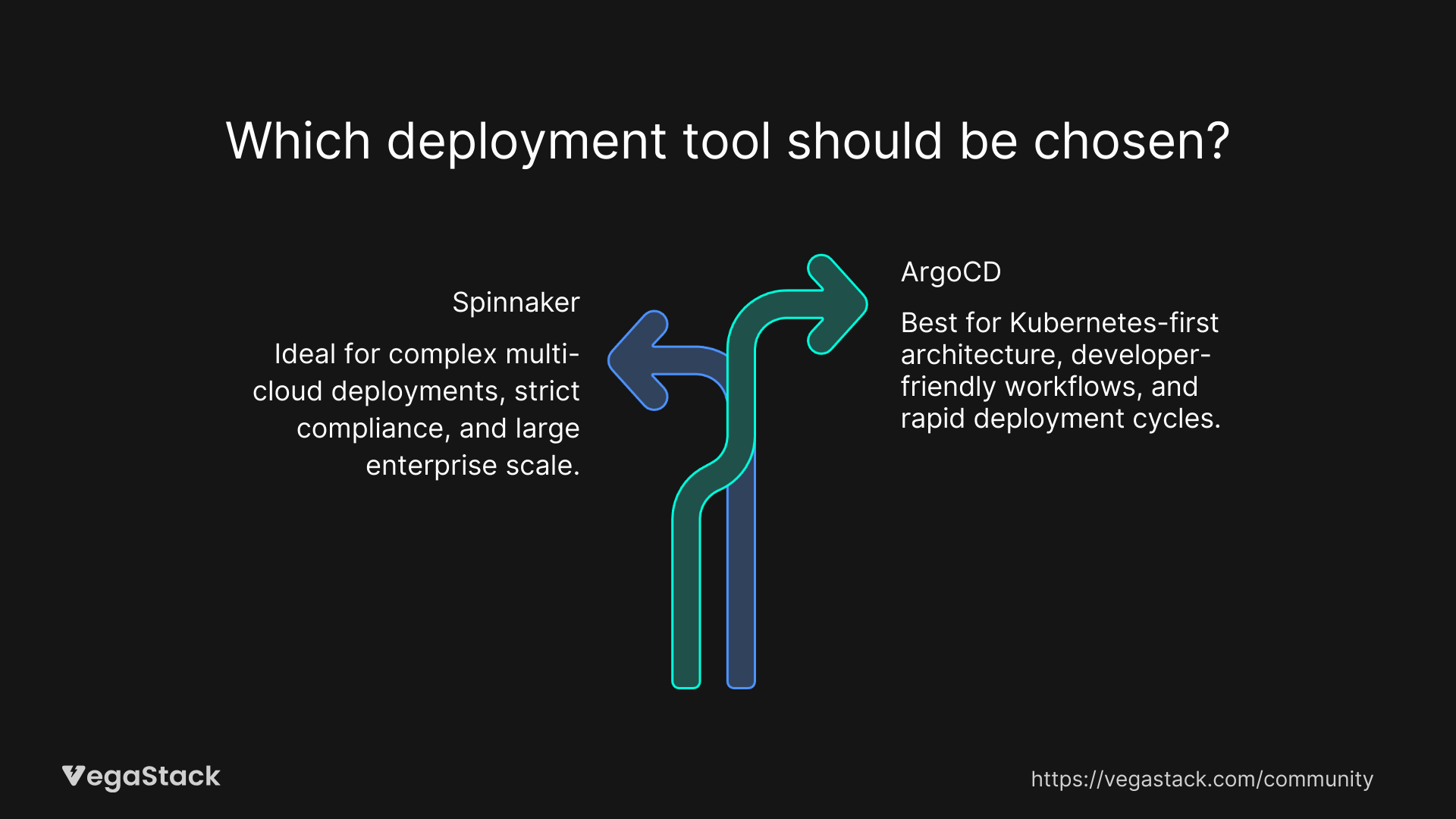
Choose Spinnaker When:
Complex Multi-Cloud Deployments: If you're deploying applications across AWS ECS, Google Cloud Run, and Azure Container Instances simultaneously, Spinnaker handles the orchestration complexity. We've seen organizations use it to maintain identical deployments across 8 different cloud services.
Strict Compliance Requirements: Organizations with SOC 2, FedRAMP, or similar compliance needs benefit from Spinnaker's built-in approval workflows and audit trails. The platform provides the deployment governance that auditors expect.
Large Enterprise Scale: Companies with 100+ microservices, multiple development teams, and complex release coordination find Spinnaker's pipeline sophistication essential. The platform scales to handle deployment complexity that would break simpler tools.
Choose ArgoCD When:
Kubernetes-First Architecture: If your applications run on Kubernetes and you want to embrace cloud-native practices, ArgoCD provides the GitOps foundation for scalable deployments. Teams managing 50+ Kubernetes applications find it invaluable.
Developer-Friendly Workflows: Organizations wanting to leverage Git workflows for deployment management benefit from ArgoCD's approach. Developers already understand Git, making deployment processes more accessible.
Rapid Deployment Cycles: Companies with frequent releases (multiple times per day) appreciate ArgoCD's automated synchronization. The platform eliminates deployment bottlenecks while maintaining consistency.
Migration and Implementation
Switching from Spinnaker to ArgoCD
The migration requires rethinking your deployment approach. Instead of complex pipelines, you'll define desired states in Git repositories. Plan for 2-3 months to migrate complex Spinnaker pipelines to ArgoCD GitOps workflows.
Key migration considerations:
- Convert pipeline stages to Kubernetes manifests
- Implement GitOps workflows for your development teams
- Establish Git repository structures for application configurations
- Migrate approval processes to Git-based workflows
Switching from ArgoCD to Spinnaker
This migration typically happens when organizations outgrow Kubernetes-only deployments. You'll need to build deployment pipelines that handle multiple cloud providers and deployment targets. The migration timeline is 3-4 months for complex multi-cloud requirements.
Key migration considerations:
- Design pipeline architectures for each deployment target
- Implement cloud provider integrations
- Establish approval workflows and security controls
- Train teams on Spinnaker's pipeline concepts
Decision Framework
Key Questions to Ask:
What's your deployment complexity? Simple Kubernetes deployments favor ArgoCD. Complex multi-cloud orchestration requires Spinnaker's sophistication.
How important is GitOps? If Git-driven workflows align with your development processes, ArgoCD provides native GitOps capabilities. Spinnaker can integrate with Git but doesn't center around it.
What's your team's expertise? Teams comfortable with Kubernetes and Git adapt quickly to ArgoCD. Organizations with dedicated DevOps engineers can leverage Spinnaker's advanced features.
What are your compliance requirements? Strict enterprise compliance often requires Spinnaker's built-in governance features. ArgoCD can meet compliance needs but requires more configuration.
Budget Considerations:
ArgoCD typically costs 60-80% less to operate than Spinnaker. The infrastructure requirements alone make Spinnaker significantly more expensive for most organizations.
Conclusion & Recommendations
Spinnaker vs. ArgoCD comes down to complexity requirements. Spinnaker excels when you need sophisticated deployment orchestration across multiple cloud providers with enterprise-grade governance. ArgoCD dominates when you want GitOps simplicity for Kubernetes-native applications.
For most organizations starting their multi-cloud journey, ArgoCD provides the right balance of capability and simplicity. You can always migrate to Spinnaker later if deployment complexity demands it.
Choose Spinnaker if you're managing complex, multi-cloud deployments with strict compliance requirements and have the expertise to operate it effectively. Choose ArgoCD if you want to follow GitOps principles for Kubernetes applications with minimal operational overhead.
The decision ultimately depends on whether you need Netflix-scale deployment complexity or prefer the elegance of GitOps-driven continuous delivery.