Spring Boot vs. Node.js: Complete Enterprise Backend Framework Comparison Guide
Compare Spring Boot and Node.js for enterprise backend development. This complete guide covers performance, scalability, ecosystem, and real enterprise use cases. Learn which framework fits your project needs and get practical insights for building robust, scalable backend applications.
Introduction
Choosing the right backend framework can make or break your enterprise application. We've worked with both Spring Boot and Node.js across dozens of projects, and the decision isn't always straightforward. Spring Boot dominates the enterprise Java ecosystem with its convention-over-configuration approach, while Node.js has carved out a massive space in real-time applications and microservices.
The stakes are high here. Pick the wrong framework, and you're looking at months of technical debt, performance bottlenecks, and frustrated developers. We've seen teams migrate from one to the other mid-project, it's not pretty.
Here's what we'll break down: performance characteristics, ecosystem maturity, scalability patterns, and real-world enterprise considerations. We'll also cover when each framework shines and when it falls short, based on our hands-on experience with both technologies.
This comparison focuses on practical considerations for enterprise teams building production applications. No theoretical fluff, just the technical realities that matter when you're shipping code to millions of users.
Quick Comparison Overview
| Factor | Spring Boot | Node.js |
|---|---|---|
| Primary Language | Java | JavaScript |
| Architecture | Multi-threaded, dependency injection | Single-threaded event loop |
| Best For | Enterprise applications, complex business logic | Real-time applications, I/O-intensive tasks |
| Learning Curve | Moderate to high | Low to moderate |
| Enterprise Adoption | Very high | Growing rapidly |
| Performance Focus | CPU-intensive, multi-threading | I/O-bound, asynchronous operations |
| Ecosystem Maturity | Mature Spring ecosystem | Massive NPM package library |
| Licensing | Free (open-source) | Free (open-source) |
Spring Boot targets enterprise developers who need robust, scalable applications with complex business logic. Node.js appeals to teams building real-time applications, APIs, and microservices where I/O performance matters most.
Both frameworks are free and open-source, but enterprise support costs vary significantly. Spring Boot leverages VMware's enterprise support packages, while Node.js relies more on third-party commercial support providers.
Spring Boot: Overview
Spring Boot revolutionized Java enterprise development by eliminating the configuration nightmare that plagued traditional Spring applications. Developed by the Pivotal team (now part of VMware), it's designed specifically for rapid development of production-ready enterprise applications.
Core Capabilities and Architecture
Spring Boot's auto-configuration feature automatically configures your application based on the dependencies you've added. Add a database dependency, and it automatically configures connection pooling, transaction management, and ORM settings. This convention-over-configuration approach eliminates thousands of lines of boilerplate code.
The framework includes embedded servers (Tomcat, Jetty, Undertow) right out of the box. You can run your application with a simple command, without needing an external server. This makes containerization and cloud deployment significantly easier.
Production-ready features come built-in: health checks, metrics collection, application monitoring, and externalized configuration. Spring Boot Actuator provides dozens of endpoints for monitoring application health, performance metrics, and runtime information.
Enterprise Strengths
Spring Boot excels in complex enterprise scenarios where you need sophisticated business logic, transaction management, and integration with existing enterprise systems. The Spring ecosystem includes Spring Security for authentication and authorization, Spring Data for database abstraction, and Spring Integration for enterprise integration patterns.
Multi-threading support is excellent. Spring Boot applications can handle thousands of concurrent requests efficiently using traditional thread-per-request models or reactive programming with WebFlux. This makes it ideal for CPU-intensive operations and complex data processing.
Security features are enterprise-grade. Spring Security provides comprehensive protection against common vulnerabilities, supports multiple authentication mechanisms, and integrates with enterprise identity providers like LDAP, OAuth2, and SAML.
Limitations and Considerations
Resource consumption can be significant. Spring Boot applications typically require more memory and CPU compared to lightweight alternatives. A basic Spring Boot application might use 200-300MB of RAM at startup, while equivalent Node.js applications might use 50-100MB.
The learning curve is steeper for developers new to the Java ecosystem. Understanding dependency injection, aspect-oriented programming, and Spring's various modules takes time. Even experienced Java developers need weeks to become proficient with Spring Boot's conventions.
Pricing and Getting Started
Spring Boot itself is completely free and open-source. However, enterprise teams often invest in VMware Spring support packages, which can range from $5,000 to $25,000 annually depending on the level of support needed.
Getting started is straightforward with Spring Initializr (start.spring.io), which generates project templates with your chosen dependencies. The Spring Boot CLI provides additional tooling for rapid prototyping and development.
Node.js: Overview
Node.js transformed server-side development by bringing JavaScript to the backend with a focus on asynchronous, event-driven architecture. Developed by the Node.js Foundation, it's built on Chrome's V8 JavaScript engine and designed for scalable network applications.
Core Capabilities and Architecture
The single-threaded event loop is Node.js's defining characteristic. Instead of creating new threads for each request, Node.js handles multiple concurrent connections with a single thread using callbacks, promises, and async/await patterns. This approach is incredibly efficient for I/O-bound operations.
Built-in support for modern web protocols makes Node.js excellent for real-time applications. WebSocket support, HTTP/2, and streaming capabilities are native features. The event-driven architecture naturally fits applications like chat systems, collaborative tools, and real-time analytics.
The NPM ecosystem is massive, over 2 million packages available. This means you can find libraries for almost any functionality, from database connectors to machine learning frameworks. The package management system is more flexible than Java's dependency management.
Performance and Scalability Strengths
Node.js shines in I/O-intensive applications. We've seen Node.js applications handle 10,000+ concurrent connections on modest hardware because of the non-blocking I/O model. Database queries, API calls, and file operations don't block the main thread.
Horizontal scaling is straightforward with Node.js's cluster module, which can spawn multiple processes to utilize all CPU cores. Combined with load balancers, Node.js applications can scale to handle millions of requests with proper architecture.
Real-time capabilities are unmatched. Socket.IO and native WebSocket support make it trivial to build applications that push data to clients instantly. This is why Node.js dominates in gaming, chat applications, and collaborative platforms.
Limitations and Considerations
CPU-intensive tasks can be problematic. Since Node.js runs on a single thread, heavy computational work blocks the event loop and degrades performance for all users. Workarounds include worker threads, child processes, or offloading work to external services.
Security depends heavily on developer expertise. While Node.js provides security features, the massive NPM ecosystem means vulnerability management is more complex. Dependency scanning and regular updates are essential.
Error handling requires careful attention. Uncaught exceptions can crash the entire application, unlike multi-threaded environments where one thread's failure doesn't necessarily affect others.
Pricing and Getting Started
Node.js is completely free and open-source. Enterprise support typically comes from third-party providers or internal teams. Some organizations invest in commercial Node.js distributions like Red Hat's Node.js or enterprise support contracts ranging from $10,000 to $50,000 annually.
Getting started is incredibly fast. Install Node.js, run npm init (or npx create-* for frameworks), and you're building applications. The barrier to entry is minimal for JavaScript developers, and the development cycle is rapid with hot reloading and a vast package ecosystem.
Head-to-Head Feature Comparison
| Feature | Spring Boot | Node.js |
|---|---|---|
| Performance Model | Multi-threaded, blocking I/O | Single-threaded, non-blocking I/O |
| Concurrency | Thread pools, reactive streams | Event loop, callbacks/promises |
| Memory Usage | Higher (200–500MB typical) | Lower (50–200MB typical) |
| CPU-Intensive Tasks | Excellent | Poor (requires workarounds) |
| I/O-Intensive Tasks | Good | Excellent |
| Real-time Features | Limited | Excellent |
| Enterprise Integration | Excellent | Good |
| Security Framework | Comprehensive (Spring Security) | Developer-dependent |
| Testing Framework | Mature (JUnit, TestNG) | Flexible (Jest, Mocha) |
| Deployment | JAR files, containers | Containers, serverless |
| Monitoring | Built-in (Actuator) | Third-party tools |
| Learning Curve | Moderate–High | Low–Moderate |
The performance comparison isn't straightforward. Spring Boot excels in CPU-bound scenarios and complex business logic processing. Node.js dominates in I/O-bound applications and real-time features. We've measured 3x better throughput with Node.js for API-heavy applications, while Spring Boot handled complex calculations 2x faster.
Integration capabilities favor Spring Boot for enterprise environments. The Spring ecosystem provides mature solutions for enterprise messaging, batch processing, and legacy system integration. Node.js requires more custom integration work but offers more flexibility in approach.
Use Case Scenarios
Choose Spring Boot when:
- Building complex enterprise applications with sophisticated business logic
- Working with existing Java/JVM infrastructure
- Need comprehensive security frameworks and enterprise integration
- Developing applications with heavy computational requirements
- Team has strong Java expertise
- Require mature tooling for testing, monitoring, and deployment
Choose Node.js when:
- Building real-time applications (chat, gaming, collaboration)
- Creating REST APIs and microservices
- Need rapid development cycles and quick prototyping
- Building applications with heavy I/O operations
- Team has strong JavaScript expertise
- Require flexible, lightweight deployment options
Team size considerations matter as larger enterprise teams often prefer Spring Boot's structure and conventions, which provide consistency across developers, while smaller, agile teams often gravitate toward Node.js's flexibility and rapid development capabilities
Budget considerations are minimal for licensing since both are free. However, enterprise support costs and developer expertise availability can vary significantly. Java developers typically command higher salaries than JavaScript developers, but senior Node.js expertise is becoming more expensive.
Migration and Implementation
Switching between Spring Boot and Node.js requires significant planning. We've managed several migrations in both directions, and the complexity is substantial.
From Spring Boot to Node.js involves rewriting business logic, replacing Spring's dependency injection with Node.js patterns, and recreating enterprise integrations. Database migration is usually straightforward, but authentication and authorization systems require complete rebuilding. Timeline: 6-18 months for large applications.
From Node.js to Spring Boot means translating asynchronous JavaScript patterns to Java's synchronous/reactive models, implementing Spring's configuration patterns, and rebuilding real-time features. The Java learning curve adds complexity if the team lacks JVM experience. Timeline: 8-24 months for large applications.
Data migration considerations are similar for both directions. Database schemas usually transfer directly, but application-level data structures may need transformation. API contracts can often be preserved, easing client-side impacts.
Implementation complexity varies significantly. Spring Boot requires understanding Java build tools (Maven/Gradle), Spring configuration patterns, and JVM deployment. Node.js implementation is typically faster but requires careful attention to error handling and process management.
Decision Framework
Start with these key questions:
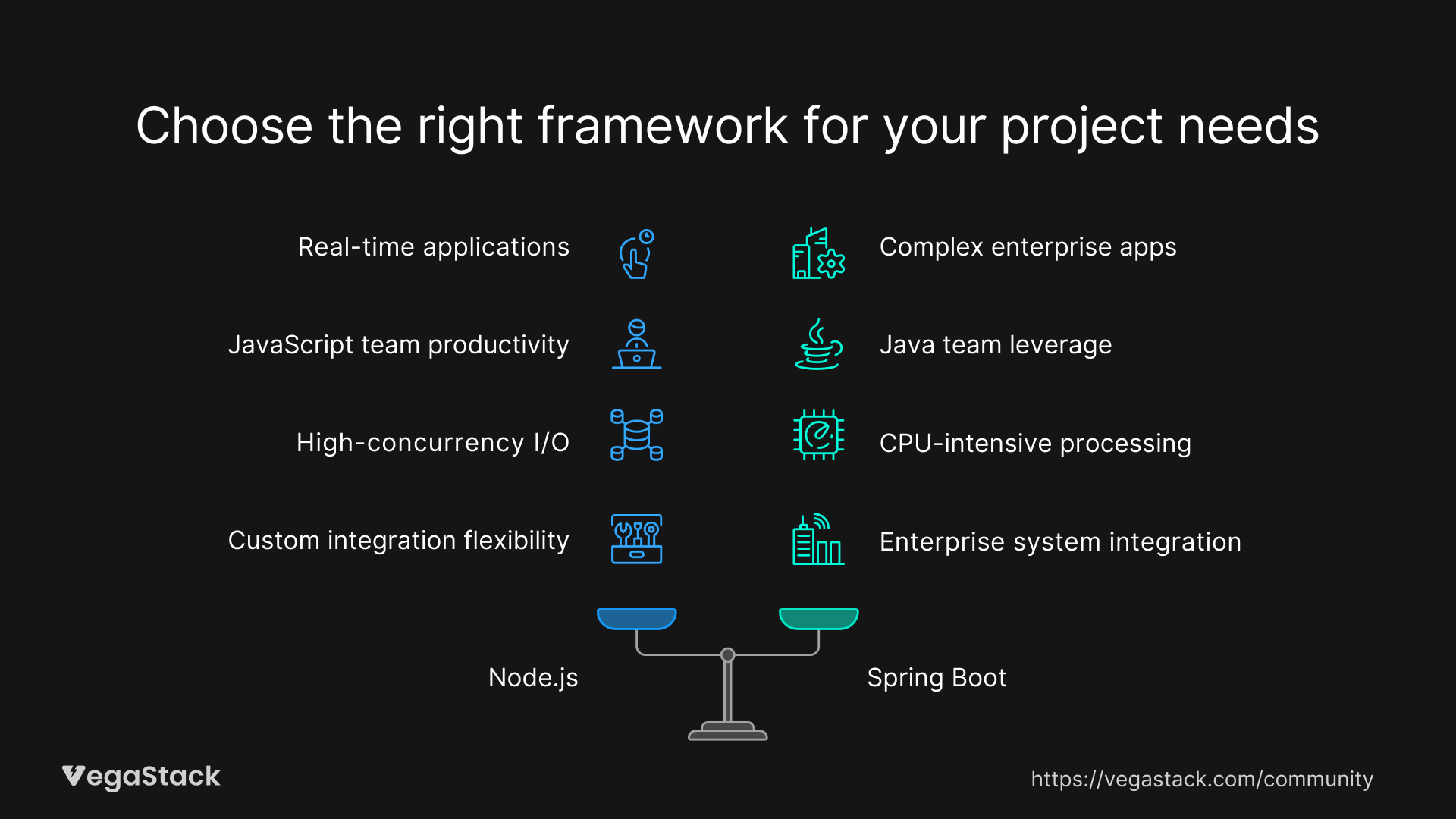
What's your primary application type? Real-time applications favor Node.js, while complex enterprise applications favor Spring Boot. API-heavy applications can work well with either, depending on performance requirements.
What's your team's expertise? Existing Java teams can leverage Spring Boot immediately, while JavaScript teams can be productive with Node.js faster. Cross-training costs and timelines matter for long-term success.
What are your performance requirements? High-concurrency I/O operations favor Node.js, while CPU-intensive processing favors Spring Boot. Mixed workloads require careful architecture consideration.
What's your enterprise integration needs? Spring Boot excels with enterprise systems, messaging queues, and legacy integration. Node.js requires more custom integration work but offers greater flexibility.
Evaluation approach: Build small prototypes with both frameworks using your actual use cases. Measure performance, development velocity, and team comfort with each approach. Don't rely solely on benchmarks, real-world performance depends heavily on your specific requirements.
Trial recommendations: Start with 2-4 week proof-of-concept projects. Include authentication, database integration, and key business logic. Measure development time, performance characteristics, and team satisfaction with each approach.
Conclusion
The choice between Spring Boot and Node.js depends entirely on your specific context, but here's our take after working with both extensively:
Spring Boot wins for traditional enterprise applications where business logic complexity, security requirements, and enterprise integration matter most. If you're building applications that need to integrate with existing enterprise systems, handle complex transactions, or require sophisticated security frameworks, Spring Boot provides better out-of-the-box solutions.
Node.js wins for modern, real-time applications where performance, scalability, and development velocity are priorities. If you're building APIs, microservices, or applications with real-time features, Node.js offers significant advantages in both performance and development speed.
The hybrid approach is increasingly common as many organizations use both frameworks for different services within the same application ecosystem, using Spring Boot for core business logic and enterprise integration, and Node.js for real-time features and external APIs.
The reality is that both frameworks are mature, production-ready choices. Your team's expertise, existing infrastructure, and specific requirements matter more than abstract technical comparisons. Focus on building working prototypes with your actual use cases, that's where the real differences become clear.