How Swiggy Achieved 4% Better Delivery Predictions and $3.5K Annual Cost Savings Through Advanced ML Architecture
Discover how Swiggy improved delivery predictions by 4% while saving $3.5K annually through advanced ML architecture. Learn their proven optimization strategies, model efficiency techniques, and cost reduction approaches. Get real insights on building efficient ML systems that deliver results.
Introduction
When India's leading food delivery platform faces the challenge of predicting delivery times across millions of orders daily, getting it wrong means disappointed customers and lost business. Swiggy's data science team recently cracked a complex puzzle: how to accurately predict each stage of the delivery journey while dramatically reducing operational costs. Their innovative approach to combining multiple deep learning models resulted in a 4% improvement in delivery prediction accuracy and eliminated $3,500 in annual infrastructure costs.
The challenge wasn't just technical complexity, it was about reimagining how machine learning models could work together more intelligently. Instead of treating each part of the delivery process as separate problems, Swiggy's team discovered that the real breakthrough came from understanding the interconnected nature of logistics operations. Their solution offers valuable insights for any organization wrestling with complex, multi-stage prediction challenges.
The Multi-Layered Delivery Prediction Challenge
According to the Swiggy team, their delivery process involves multiple interdependent stages, from restaurant preparation time to traffic-adjusted delivery estimates. Each stage affects the next, creating a cascade of dependencies that traditional single-model approaches struggle to capture effectively.
Consider a typical food order: the restaurant's current workload affects preparation time, which influences when the delivery partner should arrive, which impacts the final delivery promise to the customer. Traditional approaches treated these as separate prediction problems, leading to compounding errors and misaligned expectations.
The business stakes were significant. Inaccurate delivery predictions directly impact customer satisfaction, restaurant partnerships, and delivery partner efficiency. With millions of orders processed daily across diverse markets, from busy metropolitan areas to smaller cities with different traffic patterns, the complexity multiplied exponentially.
The Strategic Decision Point
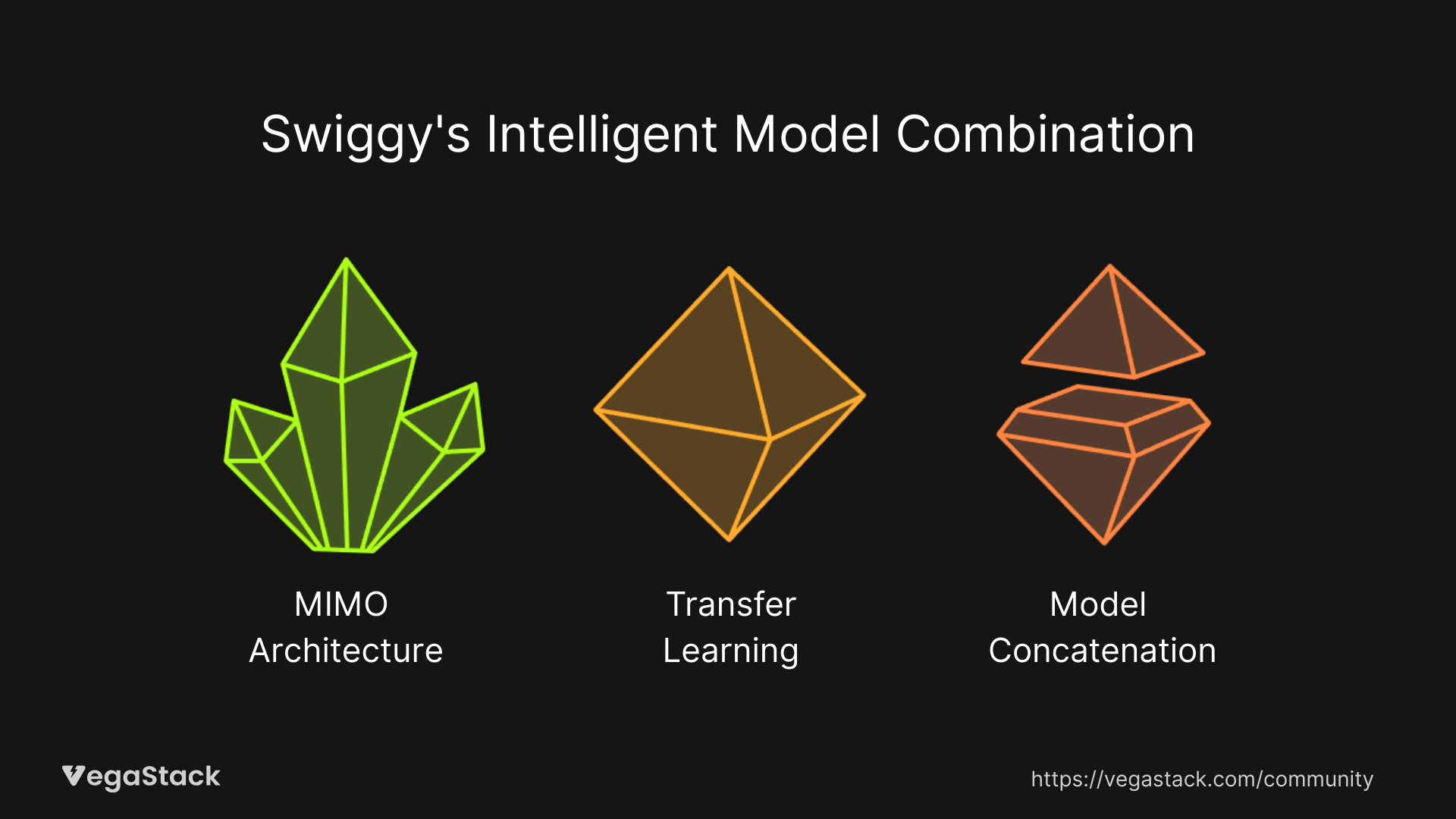
Swiggy's team realized that their biggest opportunity lay not in perfecting individual models, but in rethinking how multiple models could collaborate. They identified three key architectural approaches that could address their interconnected prediction challenges:
Multi-Input Multi-Output (MIMO) Networks for handling the delivery process as a unified system rather than separate stages. Transfer Learning for adapting models to different regional characteristics and restaurant types without starting from scratch. Model Concatenation for combining specialized models while maintaining simplicity in the engineering pipeline.
The decision to pursue all three approaches simultaneously was driven by the recognition that different aspects of their prediction challenges required different solutions, but all needed to work together seamlessly.
Solution Architecture: Three Pillars of Intelligent Model Combination
MIMO Architecture: Treating Delivery as a Unified System
Rather than building separate models for each delivery stage, Swiggy implemented a MIMO architecture that considers the entire delivery journey as a single, interconnected problem. This approach uses shared features across all delivery stages and trains the model to predict multiple outputs simultaneously.
The key insight was treating delivery logistics like a symphony orchestra, each section must be coordinated with the others to create harmony. The MIMO model learns the relationships between preparation time, pickup logistics, and final delivery, resulting in predictions that naturally align across all stages.
Transfer Learning: Adapting to Local Nuances
Swiggy's operations span diverse markets with unique characteristics. Traffic patterns in tier-1 cities during office hours differ significantly from smaller cities, and preparation times vary dramatically between fast-food restaurants and specialty confectioneries.
The team developed specialized models for different scenarios, then froze their learned weights and transferred them to a combined model for prediction. This approach captures local nuances while maintaining a unified serving infrastructure, essentially creating a model that “remembers” the lessons learned from each specific context.
Model Concatenation: Simplifying Complex Workflows
For scenarios requiring multiple model outputs to flow through their engineering pipeline, Swiggy chose an elegant concatenation approach. They override the model class's call method to invoke multiple independently trained models with a single inference call.
This solution allows different models to feed predictions to one another (mimicking real operational dependencies) while maintaining separate development workflows and simplifying the engineering infrastructure.
Implementation Success: Overcoming Real-World Challenges
The implementation revealed several critical insights about deploying complex ML architectures in production environments. The team discovered that maintaining model independence during development while ensuring seamless integration during serving required careful architectural planning.
One significant challenge was ensuring that the concatenated models could be serialized effectively for deployment. By freezing individual model weights and carefully managing the combined model's call method, they achieved a system that maintains the benefits of specialized models while presenting a unified interface to the serving infrastructure.
The transfer learning implementation required particular attention to weight management and model freezing techniques. The team found that this approach improved prediction accuracy and accelerated development cycles by enabling parallel model development across different use cases.
Measurable Business Impact
The results speak to the power of thoughtful ML architecture decisions:
Delivery Prediction Improvements:
- 4% increase in bi-directional compliance for food order predictions
- 4.2% improvement in bi-directional compliance for preparation time predictions
- Enhanced customer satisfaction through more accurate delivery promises
Operational Efficiency Gains:
- $3,500 annual cost savings through model consolidation
- Streamlined engineering pipeline reducing maintenance overhead
- Faster parallel development enabling quicker response to market needs
Strategic Capabilities:
- Foundation for hyperlocal model deployment across different city tiers
- Enhanced ability to adapt to regional variations in traffic and restaurant behavior
- Improved cross-domain application possibilities for future use cases
The bi-directional compliance metric, measuring the percentage of predictions within acceptable error margins, directly correlates to customer satisfaction and operational efficiency, making these improvements particularly valuable for business outcomes.
Key Lessons for ML Architecture Design
Embrace System-Level Thinking: Rather than optimizing individual models in isolation, consider how predictions flow through your business processes. Swiggy's MIMO approach succeeded because it matched the technical architecture to the operational reality.
Leverage Specialization Through Transfer Learning: When serving diverse markets or use cases, specialized models can capture important nuances that generic approaches miss. The key is finding efficient ways to combine this specialization.
Prioritize Engineering Simplicity: Complex ML architectures can create maintenance burdens. Swiggy's concatenation approach shows how sophisticated model combinations can be achieved while maintaining clean engineering interfaces.
Develop Models in Parallel: The ability to train specialized models independently while combining them for serving enables faster development cycles and better resource utilization across team members.
Focus on Business-Relevant Metrics: Technical improvements only matter if they translate to business outcomes. Swiggy's focus on delivery compliance directly connects to customer satisfaction and operational efficiency.
Future Applications and Industry Implications
This architectural approach has broad applications beyond food delivery. Any business dealing with multi-stage processes, from supply chain optimization to customer journey prediction, can apply similar principles. The combination of MIMO architectures, transfer learning, and intelligent model concatenation provides a framework for tackling complex, interconnected prediction challenges.
The cost savings and efficiency gains demonstrate that sophisticated ML doesn't always require expensive infrastructure investments. Sometimes the biggest improvements come from rethinking how existing capabilities can work together more intelligently.
Organizations should consider how their prediction challenges might benefit from system-level thinking rather than isolated model optimization. The tools and techniques Swiggy employed are accessible to teams with standard deep learning capabilities, making this approach broadly applicable across industries.
Conclusion
Swiggy's experience demonstrates that breakthrough improvements in ML applications often come not from individual model perfection, but from intelligent architectural decisions about how models work together. Their 4% improvement in prediction accuracy and $3,500 cost savings resulted from treating their delivery prediction challenge as an interconnected system rather than separate problems.
The combination of MIMO architectures, transfer learning, and model concatenation provides a powerful toolkit for organizations facing similar multi-stage prediction challenges. As businesses increasingly rely on ML for operational decisions, these architectural insights become crucial for achieving both technical excellence and business impact.