

Introduction
Balancing agility and reliability in modern IT operations is a challenge, especially as data complexity grows. Site Reliability Engineering (SRE) aims to address these challenges, but it often struggles with the sheer volume of data and incidents.
AIOps offers a solution by using AI and machine learning to enhance SRE, enabling faster incident resolution, reducing noise, and automating tasks. This integration is crucial for maintaining efficient and reliable operations in increasingly complex environments.
SRE in Modern IT Operations
Site Reliability Engineering (SRE) has become a cornerstone of modern IT operations, combining software engineering practices with IT infrastructure management to ensure systems are reliable, scalable, and efficient. SRE, first introduced at Google, connects development and operations by leveraging engineering practices to address operational challenges.
Unlike traditional IT operations, SRE emphasizes automation and continuous improvement, making it more agile and adaptable. This approach allows teams to manage complex, distributed systems effectively while minimizing downtime and improving user experience. SRE's focus on reliability is critical as organizations increasingly rely on complex, cloud-based infrastructures.
By establishing clear service level objectives (SLOs) and error budgets, SRE teams balance the need for innovation with system stability, ensuring that operational goals align with business needs.
The distinction between SRE and DevOps lies in their focus—while DevOps enhances collaboration and continuous delivery, SRE adds a layer of reliability and performance monitoring, making it an essential practice for organizations aiming to maintain high availability and resilience in their IT operations.
Challenges in SRE
Site Reliability Engineering (SRE) faces several challenges, especially as IT environments become increasingly complex. One of the primary challenges is managing the vast amount of data generated by modern systems. SRE teams often struggle to filter out noise from critical alerts, leading to inefficiencies in incident management.
Additionally, the growing complexity of distributed systems makes it difficult to maintain visibility and control, leading to potential reliability issues. Finally, balancing rapid innovation with system stability remains a significant hurdle, as SRE teams must ensure that new features don't compromise overall system reliability.
Introduction to AIOps
AIOps, or Artificial Intelligence for IT Operations, leverages AI, machine learning, and big data to enhance the efficiency and effectiveness of IT operations. By analyzing vast amounts of operational data, AIOps identifies patterns, predicts potential issues, and automates routine tasks.
Its core components include data ingestion, real-time processing, and advanced analytics, all working together to streamline operations. As IT environments grow in complexity, AIOps becomes increasingly vital in reducing noise, speeding up incident resolution, and providing deeper insights into system performance, ultimately supporting more intelligent and automated operations.
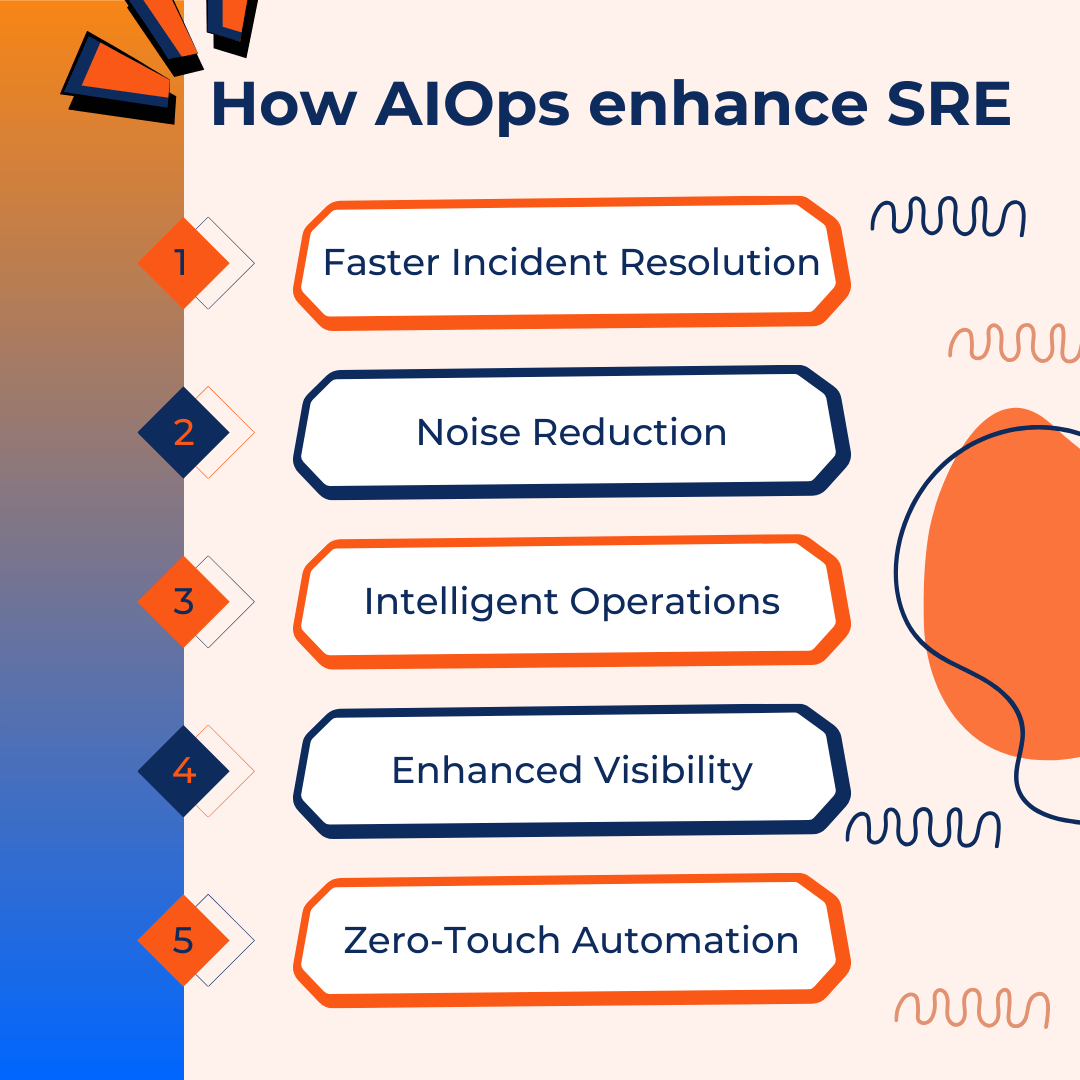
How AIOps enhance SRE
AIOps significantly enhances Site Reliability Engineering (SRE) by introducing AI-driven capabilities that address some of the most pressing challenges in modern IT operations.
One major improvement is faster incident resolution, achieved through predictive analytics that identify and mitigate potential issues before they escalate. AIOps also reduces noise by filtering out false alerts and prioritizing critical incidents, allowing SRE teams to focus on key issues.
Furthermore, AIOps supports intelligent operations by automating routine tasks and enabling real-time data analysis, leading to quicker, data-driven decision-making. Enhanced visibility is another benefit, with AIOps offering real-time monitoring and transparency across the entire delivery chain. Such insights are essential for ensuring system reliability in intricate environments.
AIOps also enables zero-touch automation, reducing the need for manual interventions by automating processes across diverse environments. Finally, AIOps facilitates continuous improvement by leveraging operational data to drive ongoing enhancements, ensuring that incident management and system reliability are aligned with overall software development life cycle (SDLC) goals.
By integrating AIOps into SRE, organizations can achieve a more resilient, efficient, and proactive approach to managing IT operations, ultimately leading to more reliable systems and better user experiences.
Case Studies/Examples
Real-world case studies highlight the transformative impact of AIOps on Site Reliability Engineering (SRE). For example, a major e-commerce platform implemented AIOps to streamline its incident management process.
By using AI-driven analytics, the platform reduced its incident resolution time by 40%, significantly improving user experience during peak traffic periods. Another example is a financial services firm that leveraged AIOps to enhance its monitoring capabilities, resulting in a 30% reduction in false alerts and better resource allocation.
These success stories underscore the tangible benefits of integrating AIOps into SRE practices, demonstrating improvements in reliability, efficiency, and overall system performance.
Future Trends in AIOps and SRE
As AI and machine learning technologies progress, the future of AIOps and SRE is set for significant growth and transformation. We can expect wider adoption of AIOps across industries as organizations recognize its potential to automate and enhance reliability in increasingly complex IT environments.
The role of SRE is also set to evolve, with a greater focus on integrating AI-driven insights into day-to-day operations. As AIOps matures, it will likely drive even more intelligent automation, predictive capabilities, and proactive system management, further blurring the lines between human and machine-led operations.
This shift will require SRE teams to adapt, embracing new tools and strategies to maintain reliability in the face of growing data volumes and operational complexity.
The continued convergence of AIOps and SRE will not only enhance system reliability but also push the boundaries of what's possible in IT operations, leading to more resilient, efficient, and forward-thinking organizations.
Key Takeaways
- AIOps Enhances SRE: Integrating AIOps with SRE leads to faster incident resolution, noise reduction, and intelligent automation.
- SRE's Role: SRE combines engineering principles with IT operations to ensure system reliability and scalability.
- Operational Challenges: SRE teams face challenges such as managing large data volumes and balancing innovation with stability.
- Real-World Success: Case studies show AIOps can significantly improve reliability and efficiency in diverse industries.
- Future Trends: AIOps and SRE will continue to evolve, with increased automation and AI-driven operations shaping the future of IT management.
Conclusion
Integrating AIOps into Site Reliability Engineering (SRE) offers significant improvements in IT operations. AIOps enhances incident management with AI-driven tools, predictive analytics, and automation, leading to faster resolutions and reduced false alerts. The increased visibility and zero-touch automation streamline processes, allowing SRE teams to focus on strategic tasks and continuous improvement.
As technology evolves, the role of AIOps in SRE will expand, promising even greater efficiency and agility. Embracing these advancements will be crucial for maintaining reliability and competitiveness in the rapidly changing digital landscape.